
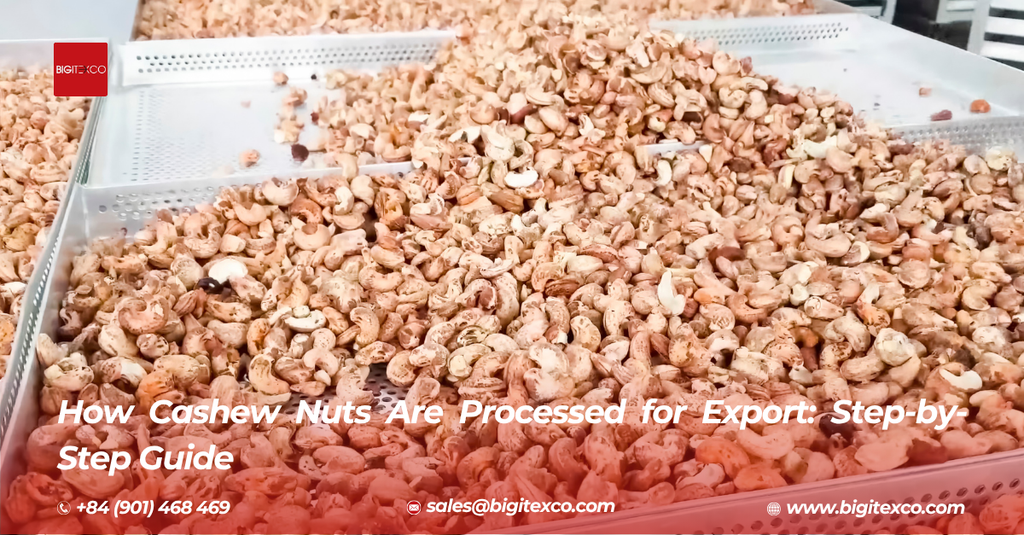
Cashew processing is a multi-stage operation that turns raw cashew nuts into clean, graded kernels ready for international buyers.
Understanding how cashew nuts are processed for export helps importers evaluate supplier capability, product quality and consistency before placing an order.
The process normally includes raw nut inspection, conditioning, shelling, drying, peeling, grading, quality control and final packing. Each stage can affect kernel appearance, moisture, breakage, food safety and shelf life.
Summary
Export cashew kernels are produced through a controlled sequence of raw nut selection, heat treatment, shelling, kernel drying, peeling, grading, quality inspection and packaging.
The objective is not only to remove the shell. Processors must also control moisture, defects, kernel size, colour, breakage, contamination and packaging so that the final product meets the buyer’s specification and destination-market requirements.
In this article
1. How Are Raw Cashew Nuts Selected?
The process begins with raw cashew nuts, commonly called RCN.
Before production, processors evaluate raw materials based on factors such as nut size, moisture, foreign matter, shell condition and expected kernel outturn. Raw nut quality is important because it directly influences the amount and quality of finished kernels that can be produced.
Poor-quality RCN may result in more broken kernels, discoloration, defects or lower processing yield. For this reason, careful sourcing and incoming inspection are important parts of export cashew production.
2. Why Are Cashews Heat-Treated Before Shelling?
Raw cashew nuts have a hard outer shell containing cashew nut shell liquid, commonly called CNSL. The shell must therefore be treated before the kernel can be safely removed.
Processors may use methods such as steaming or controlled heat treatment to condition the shell and make it easier to open.
The objective is to soften or prepare the shell while protecting the kernel inside. Poor control during this stage can increase breakage or affect kernel colour.
After conditioning, the nuts are cooled and prepared for shelling.
3. How Are Cashew Kernels Shelled and Dried?
During shelling, the outer shell is removed while keeping as much of the kernel intact as possible.
Shelling may be carried out using mechanical equipment, manual systems or a combination of both. Processor skill and equipment performance can significantly affect the percentage of whole kernels produced.
After shelling, the kernel still has a thin skin called the testa.
The kernels are therefore dried under controlled conditions. This reduces moisture and helps loosen the testa so that it can be removed more easily during peeling.
Moisture control is especially important because excessive drying can make kernels brittle, while insufficient drying can make peeling more difficult.
4. How Are Cashews Peeled and Graded?
Once the kernels have been dried, the testa is removed through peeling.
After peeling, kernels are inspected and separated according to size, colour, shape and condition.
Whole-kernel grades commonly traded internationally include WW180, WW210, WW240, WW320 and WW450, while broken kernels may be classified as splits, butts or pieces.
The lower the grade number, the larger the average whole kernel. For example, WW240 is generally larger than WW320.
However, size is only one quality parameter. Colour, moisture, defects, breakage and food-safety requirements must also be considered.
For more information about grade and quality requirements, see our Cashew Nut Quality Standards for Export guide.
5. What Quality Checks Are Carried Out?
Quality control should continue throughout the production process rather than only at the final packing stage.
Processors may monitor moisture, kernel count, colour, breakage, foreign matter, defects, sensory quality and lot traceability. Depending on the destination market and buyer specification, laboratory testing may also include microbiological parameters, aflatoxins and pesticide residues.
The final lot should be checked against the agreed product specification before shipment.
BIGITEXCO Note: Two products can have the same commercial grade but still differ in colour, moisture, defect levels, breakage and food-safety specifications. Buyers should therefore review the full specification rather than relying only on the grade name.
6. How Are Export Cashews Packed?
After grading and final inspection, cashew kernels are packed to protect them from moisture, oxygen, contamination and physical damage during storage and transportation.
Buyers should confirm the net weight, inner packaging material, carton specification, lot coding, packing method and shipping marks before production. Depending on the product and customer, kernels may be packed using vacuum, gas flushing or other suitable systems.
The packaging must also support traceability so that each carton can be linked to the relevant production lot.
For retail or private-label products, additional processing may include roasting, seasoning, coating and retail packing before final shipment.
7. How Should Buyers Evaluate a Cashew Processor?
When choosing a supplier, buyers should look beyond price and production capacity.
A reliable processor should be able to explain its production flow, maintain traceability, provide clear product specifications and demonstrate consistent quality control.
Buyers should also evaluate whether the supplier can meet their required grade, moisture, defect limits, food-safety standards, packaging format, production volume and shipment schedule.
Samples and trial orders can be useful before moving to larger commercial volumes, particularly when working with a new supplier.
For a complete sourcing overview, see our How to Import Cashew Nuts from Vietnam guide.
Cashew Processing Flow at a Glance
Raw Cashew Nuts → Inspection → Heat Treatment → Shelling → Kernel Drying → Peeling → Grading → Quality Control → Packing → Export
This simple flow shows why cashew processing requires much more than shell removal. Each step can influence the final kernel quality.
Conclusion
Understanding how cashew nuts are processed for export helps buyers better evaluate product quality and supplier capability.
A typical export process includes raw nut selection, heat treatment, shelling, drying, peeling, grading, quality control and final packaging.
The most reliable suppliers control quality throughout the entire process and match the finished lot to an agreed technical specification before shipment.
At BIGITEXCO, we supply Vietnamese cashew kernels for international B2B customers and support bulk supply, customized specifications and OEM/private-label requirements.
Looking for Cashew Nuts from Vietnam?
Frequently Asked Questions
Why are cashew nuts heated before shelling?
Heat treatment helps condition the shell so that the kernel can be removed more efficiently while reducing unnecessary damage.
Why are kernels dried after shelling?
Drying helps control moisture and loosens the testa, making the kernels easier to peel.
What happens after cashews are peeled?
The kernels are inspected and graded according to size, colour, shape and quality before packing.
Are all export cashews processed in the same way?
The main stages are similar, but equipment, processing methods, quality standards and packaging systems can vary between processors.
Related Articles
Cashew Nut Quality Standards for Export: A Buyer’s Guide