
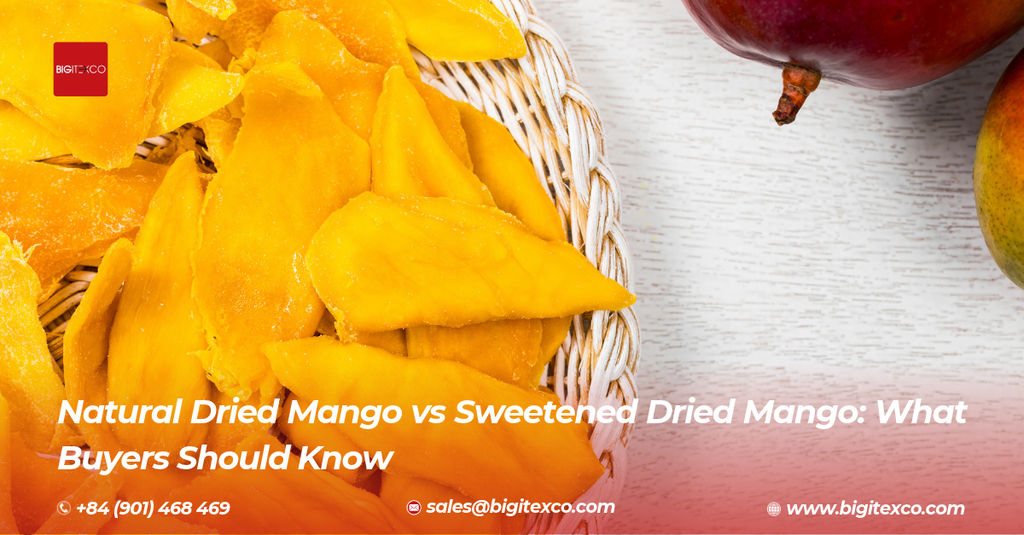
Dried mango may look like a simple product, but the formulation can significantly affect its taste, texture, appearance, price and target market.
One of the most common sourcing decisions is choosing between natural dried mango vs sweetened dried mango.
Natural or no-added-sugar products generally rely more heavily on the fruit’s own sweetness, while sweetened dried mango contains additional sugar during processing. However, sugar is only one difference. Buyers should also consider moisture, SO₂, texture, colour, ingredients, shelf life and consumer positioning before comparing quotations.
Summary
The main difference between natural and sweetened dried mango is whether sugar is added during processing.
Natural or no-added-sugar dried mango retains the mango’s naturally occurring sugars and generally delivers a more fruit-forward flavour. Sweetened dried mango contains added sugar, usually creating a sweeter and often softer product.
However, “natural” does not automatically mean no preservatives or no sulphites. Buyers should always check the actual ingredient list and product specification rather than relying only on the product name.
In this article
- What is the main difference?
- How do the ingredients differ?
- How do taste and texture compare?
- Does moisture differ?
- What about SO₂ and preservatives?
- How do labelling and nutrition differ?
- Which product is more suitable for buyers?
- What should buyers compare before ordering?
1. What Is the Difference Between Natural and Sweetened Dried Mango?
The simplest difference is the formulation.
Natural dried mango is generally produced by removing water from mango without adding sugar. The finished product still contains considerable natural sugar because fresh mango itself contains naturally occurring sugars.
Sweetened dried mango, by contrast, has additional sugar incorporated during processing. Depending on the production method, sugar may influence sweetness, texture, colour and moisture retention.
This means “no added sugar” does not mean “sugar-free.”
For B2B sourcing, the more useful question is not whether one product is universally better, but which formulation is more suitable for the buyer’s target market.
2. How Do the Ingredients Differ?
A simple no-added-sugar product may contain mostly mango, but buyers should not assume that “natural” means the ingredient list contains only one ingredient.
Some commercially available no-added-sugar dried mango products still contain preservatives or antioxidants such as sodium metabisulphite. Other manufacturers offer products without added sugar and without preservatives.
Therefore, buyers should separate three different claims:
No added sugar refers to sugar formulation.
No added SO₂ refers to sulphite treatment.
100% mango means no additional ingredients are included.
These descriptions should not be treated as interchangeable.
Sweetened dried mango normally contains mango and added sugar, and depending on the formulation may also include citric acid, sulphites or other permitted ingredients.
3. How Do Taste and Texture Compare?
Natural dried mango generally offers a flavour profile closer to the original fruit. Sweetness depends more strongly on mango variety, ripeness and harvest conditions, so some batches may naturally taste sweeter or more acidic than others.
Sweetened dried mango tends to deliver a more consistent and pronounced sweetness because the formulation can compensate for natural variation in raw fruit.
Texture can also differ. Natural dried mango may be slightly firmer or more fruit-like, depending on its moisture level and drying process. Sweetened products can often feel softer or more pliable because the formulation and processing method influence moisture retention.
However, sugar alone does not determine texture. Moisture, slice thickness, fruit maturity and drying conditions are also important.
4. Does Moisture Differ Between the Two Products?
Moisture is one of the biggest factors determining whether dried mango feels firm, chewy or very soft.
UNECE DDP-25 specifies a maximum moisture content of 15% for untreated dried mango, while preserved products may have moisture above 15% and up to 35%. Products in the 30–35% range are considered soft or high-moisture dried mango.
This means a no-added-sugar product can still be soft if the production process is designed for a higher-moisture finished product.
Likewise, sweetened dried mango does not automatically have to be extremely soft.
For buyers, it is much more useful to specify a target moisture range and desired texture than simply asking for “soft dried mango.”
BIGITEXCO Note
When comparing samples from different suppliers, compare products with similar moisture, thickness and formulation. Otherwise, texture comparisons may be misleading.
5. What About SO₂ and Preservatives?
Added sugar and sulphites serve different purposes and should be treated as separate specification items.
Sulphur dioxide and sulphites can help maintain colour and product stability. A no-added-sugar dried mango may therefore still contain sulphites, while another supplier may offer a product with neither added sugar nor added SO₂.
For the EU market, dried mango generally falls within the dried-fruit category permitting up to 500 mg/kg total SO₂, although commercial buyers frequently request substantially lower limits. Sulphites above 10 mg/kg also become relevant to EU allergen-information requirements.
For more detail, internally link this section to your Sulphur Dioxide Limits in Dried Fruit EU article.
The safest sourcing approach is to define sugar and SO₂ separately, for example:
Added sugar: 0%
Total SO₂: ≤200 mg/kg
This is much clearer than requesting only “natural dried mango.”
6. How Do Labelling and Nutrition Differ?
A no-added-sugar dried mango can still display a relatively high total sugar value on its nutrition panel because dehydration concentrates the naturally occurring sugars in the fruit.
Therefore, buyers should distinguish between ingredient formulation and nutrition information.
If sugar has been added during production, it should be reflected appropriately in the ingredient declaration and applicable nutrition information. For private-label products entering the EU, mandatory food information must comply with Regulation (EU) No 1169/2011 and destination-market language requirements.
This distinction is particularly important for product positioning. A brand selling a no-added-sugar product should ensure that its marketing wording matches the actual formulation rather than suggesting that the product contains no sugar at all.
7. Which Product Is More Suitable for Different Buyers?
Neither formulation is automatically superior.
Natural or no-added-sugar dried mango may be more suitable for brands targeting consumers looking for a simpler ingredient list, less added sweetness or a more fruit-forward taste.
Sweetened dried mango may suit markets where buyers prioritise consistent sweetness, softer texture or a more traditional dried-fruit snack profile.
Industrial customers may also select different formulations according to the application. A bakery manufacturer, cereal producer or confectionery company may focus more on texture, moisture and cost than on retail positioning.
The correct choice therefore depends on the buyer’s consumer profile, price target, specification and destination market.
8. What Should Buyers Compare Before Ordering?
When comparing natural dried mango vs sweetened dried mango, buyers should not compare quotations based only on USD/kg.
The products should be evaluated using the same criteria: mango content, added sugar percentage, SO₂ level, moisture, cut, colour, texture, defect tolerance, packaging, shelf life and Incoterm.
A useful comparison may look like this:
| Parameter | Natural / No Added Sugar | Sweetened |
|---|---|---|
| Added sugar | 0% | Agreed percentage |
| Natural sugars | Present | Present |
| Taste | More fruit-led | Sweeter |
| Texture | Depends on moisture | Often softer |
| SO₂ | Separate specification | Separate specification |
| Colour | May be more natural/darker | Depends on process |
| Positioning | Clean/simple formulation | Mainstream sweet snack |
| Price | Depends on specification | Depends on formulation |
For a complete technical checklist covering moisture, SO₂, defects, microbiology and packaging, link this section to Dried Mango Quality Specifications for Export.
Conclusion
The difference between natural dried mango vs sweetened dried mango goes beyond whether sugar is added.
Buyers should consider the full product specification, including ingredients, moisture, texture, colour, SO₂, packaging and shelf life.
Natural dried mango can provide a more fruit-forward profile and no-added-sugar positioning, while sweetened products can deliver stronger and more consistent sweetness. Neither option is universally better—the correct choice depends on the target consumer and commercial application.
The UNECE dried mango standard also makes clear that moisture and preservation methods can significantly change the characteristics of the finished product, which is why product names alone are not enough for B2B purchasing.
At BIGITEXCO, we support international buyers with different dried mango formulations, customized specifications, bulk supply and OEM/private-label solutions.
Looking for Dried Mango from Vietnam?
Frequently Asked Questions
Does no-added-sugar dried mango contain sugar?
Yes. Mango naturally contains sugar, so a product can have 0% added sugar while still containing naturally occurring sugars.
Does natural dried mango always mean 100% mango?
No. The term can be used differently commercially. Buyers should check the ingredient list because a no-added-sugar product may still contain preservatives or other permitted ingredients.
Is natural dried mango always harder than sweetened mango?
No. Texture depends strongly on moisture, processing method, slice thickness and fruit maturity as well as formulation.
Can no-added-sugar dried mango contain SO₂?
Yes. Added sugar and sulphite treatment are separate characteristics and should be specified separately.
Related Articles
Dried Mango Quality Specifications for Export: A Buyer’s Guide