
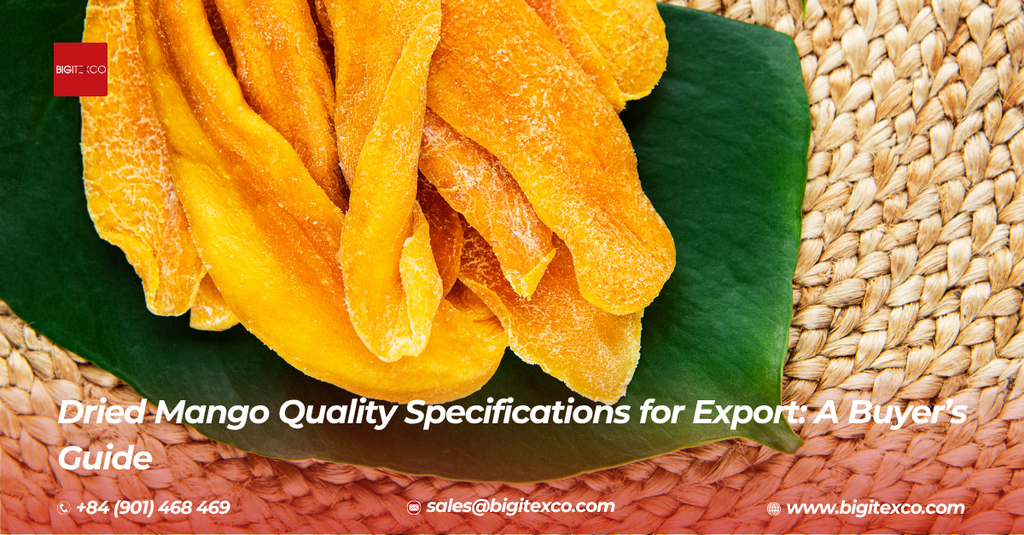
Dried mango quality is not defined by appearance alone.
For international buyers, a reliable specification should cover moisture, texture, colour, size, defects, sugar, sulphur dioxide, microbiological safety, pesticide residues, packaging and shelf life.
Understanding dried mango quality specifications for export helps importers compare suppliers correctly and gives manufacturers clear production targets before an order begins.
UNECE publishes a commercial quality standard specifically for dried mangoes, DDP-25, covering product styles, minimum quality requirements, moisture, classification, sizing and tolerances.
Summary
A complete dried mango specification should define more than just “slice” or “no sugar.”
Buyers should agree on the product style, moisture range, texture, colour, size, defect tolerance, ingredients, added sugar, SO₂ level, microbiological parameters, pesticide requirements, packaging and shelf life before production.
There is no single specification that fits every customer. The final standard should combine commercial quality references, destination-market regulations and buyer-specific requirements.
In this article
- What quality standard is used for dried mango?
- What moisture level should dried mango have?
- How should texture and colour be evaluated?
- What size and cut should buyers specify?
- How much added sugar should dried mango contain?
- What SO₂ level should buyers request?
- Which defects should be controlled?
- What food-safety parameters matter?
- What packaging should be specified?
- What documents should buyers request?
1. What Quality Standard Is Used for Dried Mango?
There is no single mandatory global commercial specification for every dried mango shipment. However, the UNECE DDP-25 Standard for Dried Mangoes provides a useful international reference for commercial quality.
The standard covers product styles such as halves, slices and pieces, and it also defines minimum quality requirements, moisture content, classification, sizing and defect tolerances. Dried mangoes may be classified as Extra Class, Class I or Class II, depending on their quality characteristics.
For actual B2B transactions, however, buyers and suppliers should agree on a written technical specification because customer requirements may be stricter than the general commercial standard.
BIGITEXCO Note
A request such as “dried mango slices” is not yet a complete specification. The buyer should also define moisture, sugar, sulphites, colour, size, texture, packaging and food-safety requirements.
2. What Moisture Level Should Dried Mango Have?
Moisture has a major influence on dried mango texture, shelf life and storage stability. According to UNECE DDP-25, untreated dried mango generally has a moisture content of not more than 15%, while mango treated with preservatives or another preservation method may have moisture above 15% and up to 35%.
Products with moisture between 30% and 35% are considered soft or high-moisture fruit. This explains why two products both sold as “dried mango” may have very different textures.
Lower-moisture products are generally firmer and drier, while higher-moisture products are usually softer, more flexible and closer to a premium soft-dried snack. For this reason, buyers should specify a measurable moisture range rather than simply requesting “soft dried mango.”
3. How Should Dried Mango Texture Be Evaluated?
Texture is one of the most important sensory criteria in dried mango sourcing. Depending on the product concept, a buyer may prefer a soft and chewy texture, a firmer texture, or a product that is flexible but not sticky.
Texture is closely related to moisture, sugar content, fruit maturity and the drying process. For retail products, consistency is particularly important because a single pack containing both extremely dry and very soft pieces can create the impression of poor production control.
A good specification should therefore describe the expected texture and connect it to a measurable moisture range.
4. How Should Colour and Appearance Be Evaluated?
High-quality dried mango should have a colour and appearance appropriate to the mango variety and production method. Buyers may request a yellow to golden-yellow appearance, good colour uniformity and limited dark or brown areas.
The specification should also define acceptable levels of black spots, surface damage, fibrous pieces, excessive crystallised sugar, visible mould or other defects.
Colour expectations should always take the formulation into account. A no-SO₂ dried mango may naturally become darker than a sulphited product, so appearance should not be evaluated without considering the processing method.
5. What Size and Cut Should Buyers Specify?
Dried mango may be supplied as slices, strips, pieces or other customized cuts. While UNECE recognises common product styles, international buyers often need more precise dimensions.
A commercial specification may define the target length, width, thickness and acceptable percentage outside the required size range. Premium retail buyers may also specify a minimum percentage of complete slices, while industrial customers may accept smaller pieces for bakery, snack mixes or food manufacturing.
The more clearly the cut is defined, the easier it becomes to compare quotations from different suppliers.
6. How Much Added Sugar Should Dried Mango Contain?
There is no universal rule requiring dried mango to contain a fixed percentage of added sugar. Depending on the product concept, dried mango may contain no added sugar, a low level of added sugar or a higher amount for a traditional sweetened product.
Buyers should clearly distinguish between added sugar and total sugars. These are not the same. Even dried mango with 0% added sugar will naturally contain sugars because fresh mango already contains naturally occurring carbohydrates.
For this reason, the formulation should state the added sugar percentage separately from the nutrition declaration.
7. What SO₂ Level Should Buyers Request?
Sulphur dioxide and sulphites may be used in dried fruit to help protect colour and improve product stability. For the EU market, dried mango generally falls within a dried-fruit category where sulphites may be permitted up to 500 mg/kg expressed as total SO₂, depending on the exact product classification.
However, the legal maximum should not be confused with the buyer’s own specification. A customer may request SO₂ ≤300 ppm, SO₂ ≤200 ppm or no added SO₂ depending on its product positioning and quality requirements.
When sulphur dioxide or sulphites are present above 10 mg/kg expressed as total SO₂, allergen-related declaration requirements also become relevant in the EU.
The specification should therefore clearly state both the maximum permitted SO₂ level and whether sulphites are intentionally added.
8. Which Physical Defects Should Be Controlled?
A dried mango quality specification should define acceptable defect levels rather than relying on vague descriptions such as “good quality.”
Typical defects may include dark spots, excessive discoloration, burnt areas, fibrous pieces, skin residue, seed fragments, foreign matter, insect damage, mould, fermentation, excessively dry pieces or excessively sticky pieces.
Whenever possible, these requirements should be converted into measurable tolerances so that both buyer and supplier can evaluate the product using the same criteria.
9. What Microbiological Parameters Should Buyers Check?
Microbiological requirements depend on the destination market, production process and buyer’s internal standards. Dried-fruit quality programmes commonly monitor parameters such as total plate count, yeast and mould, coliforms, E. coli and Salmonella.
Where microbiological criteria are contractually important, buyers should define both the limit and the test method. Suppliers should also maintain preventive controls covering hygiene, drying, handling, storage and packing because laboratory testing alone cannot replace good manufacturing practice.
10. What About Pesticide Residues and Mycotoxins?
Dried mango intended for export must meet the food-safety requirements of the destination market. For EU sales, pesticide Maximum Residue Levels vary according to the active substance, so suppliers should verify current requirements rather than applying one generic pesticide limit.
Mycotoxins may also be relevant. For dried fruits intended for final consumers in the EU, current rules generally set maximum levels of 2.0 μg/kg for aflatoxin B1 and 4.0 μg/kg for total aflatoxins, while “other dried fruits” are also subject to an ochratoxin A limit.
For a broader regulatory overview, this section should internally link to your EU Dried Fruit Import Requirements article.
11. How Should Taste and Aroma Be Evaluated?
Dried mango should have a characteristic mango flavour and aroma without undesirable notes such as rancidity, fermentation, burning, chemical odour or foreign taste.
The desired sweetness and acidity should also match the agreed formulation. For OEM products, an approved reference sample is particularly useful because sensory requirements are difficult to describe using numbers alone.
In practice, the written specification defines measurable requirements, while the approved sample demonstrates the expected appearance, flavour and texture.
12. What Packaging Should Be Included in the Specification?
Packaging can significantly affect dried mango quality after production because the product is sensitive to moisture, oxygen, heat, pest contamination and poor sealing.
Buyers should therefore confirm the complete packaging specification before production, including the net weight per carton, inner bag material, bag dimensions, carton size and packing method, such as vacuum or non-vacuum packing. The specification should also state whether the product is intended for bulk or retail use.
In addition, lot coding, shipping marks and pallet requirements should be confirmed so that finished goods can be identified, handled and shipped consistently. For long-distance export, packaging should maintain product quality throughout transportation and the agreed shelf life.
13. What Shelf Life Should Buyers Request?
Shelf life depends on the formulation and production system rather than only on the product name. Important factors include moisture, packaging barrier, sulphite use, added sugar, microbiological quality, storage temperature and processing method.
The technical specification should therefore state the target shelf life and recommended storage conditions. For private-label retail products, buyers may also require supporting shelf-life or stability information before approving mass production.
14. What Quality Documents Should Buyers Request?
The quality documentation supplied with dried mango should reflect the actual risks and contractual requirements of the product.
A typical quality file may include the Product Specification, Certificate of Analysis, ingredient list, nutrition information, moisture result, SO₂ result where applicable, microbiological results, pesticide or mycotoxin testing when required, allergen statement, packaging specification, shelf-life information and traceability data.
Depending on the buyer and destination market, the supplier may also provide food-safety certifications or a pre-shipment inspection report. Not every shipment requires every possible test, so the documentation programme should be based on product risk and buyer requirements.
15. How Should Buyers Compare Dried Mango Quotations?
Price comparisons only make sense when suppliers are quoting equivalent products.
Before comparing USD/kg, buyers should confirm that the quotations use the same product style, sugar formulation, SO₂ limit, moisture range, size, defect tolerance, packaging, testing requirements and Incoterm.
For example, a no-added-sugar, no-SO₂ soft dried mango should not be compared directly with a conventional sweetened and sulphited product based only on price per kilogram because the formulation, production process and quality requirements may be very different.
BIGITEXCO Note
The best dried mango specification converts expectations into measurable requirements. Instead of asking for “soft mango, good colour and low SO₂,” define the required moisture range, colour standard, maximum SO₂, added sugar percentage, size tolerance and packaging format.
Dried Mango Quality Specification Checklist
| Parameter | What Buyers Should Define |
|---|---|
| Product style | Slice / strip / piece |
| Ingredients | Mango + permitted ingredients |
| Added sugar | 0% or agreed level |
| Moisture | Agreed range |
| SO₂ | Maximum ppm or no added SO₂ |
| Colour | Agreed visual standard |
| Texture | Soft / chewy / firm |
| Size | Length, width, thickness |
| Defects | Agreed tolerances |
| Microbiology | Buyer / market limits |
| Pesticides | Destination-market compliance |
| Mycotoxins | Applicable regulatory limits |
| Packaging | Bulk or retail format |
| Shelf life | Agreed period and storage conditions |
Conclusion
Understanding dried mango quality specifications for export requires much more than checking colour and taste.
A reliable specification should define the product’s moisture, texture, size, colour, sugar, SO₂, defects, food-safety requirements, packaging and shelf life before production begins.
Commercial standards provide useful reference points, but the final specification should reflect both destination-market requirements and the buyer’s own quality expectations.
For importers, agreeing on these parameters in advance helps reduce misunderstandings, quality claims and inconsistent shipments.
At BIGITEXCO, we supply dried mango products for international B2B customers and support customized specifications, bulk supply and OEM/private-label requirements.
Looking for Dried Mango from Vietnam?
Frequently Asked Questions
What moisture level should dried mango have?
UNECE DDP-25 specifies a maximum of 15% moisture for untreated dried mango. Preserved products may have moisture above 15% and up to 35%, with products between 30% and 35% identified as soft/high-moisture fruit.
What moisture level should dried mango have?
UNECE DDP-25 specifies a maximum of 15% moisture for untreated dried mango. Preserved products may have moisture above 15% and up to 35%, with products between 30% and 35% identified as soft/high-moisture fruit.
Is no-added-sugar dried mango sugar-free?
No. Mango naturally contains sugars, so a product can contain no added sugar while still showing substantial total sugar in its nutrition declaration.
What is the EU sulphite limit for dried mango?
Dried mango generally falls under the EU category permitting up to 500 mg/kg of sulphur dioxide/sulphites expressed as total SO₂. Buyer specifications may be considerably lower.
Should dried mango always contain sulphites?
No. Dried mango can be produced without added sulphites, although colour, processing method and shelf-life characteristics may differ.
Related Articles
EU Dried Fruit Import Requirements: 2026 Compliance Guide