
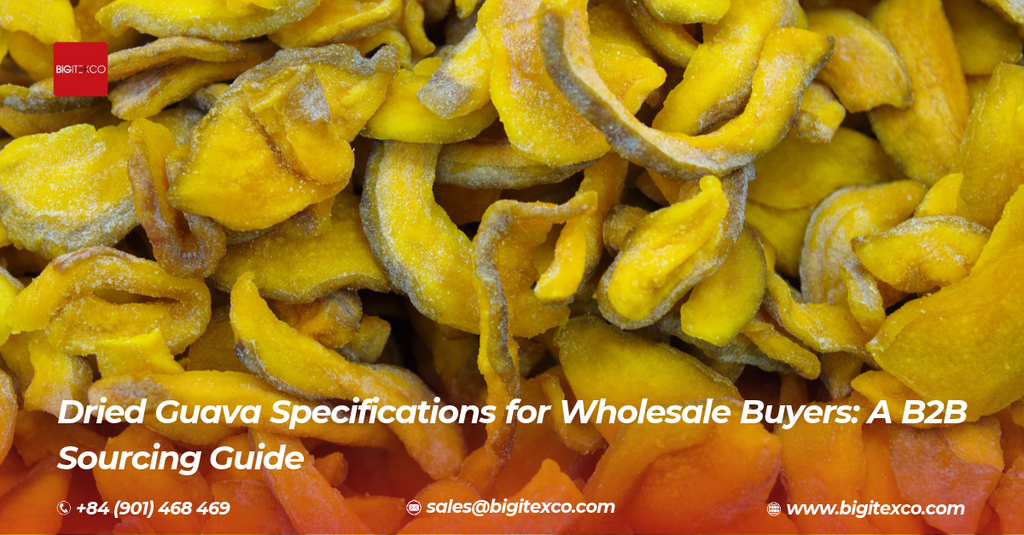
Dried guava is a tropical fruit product used in snack ranges, retail packaging, food manufacturing, and private-label product development. For importers and wholesale buyers, selecting the right dried guava involves more than checking its appearance or price per kilogram.
Product specifications can vary depending on the guava variety, maturity, drying method, added ingredients, moisture level, and intended application. These differences affect the product’s flavor, texture, shelf life, packaging requirements, and suitability for different markets.
Before placing a bulk order, buyers should establish clear specifications and confirm that the supplier can consistently meet them.
This guide explains the key dried guava specifications that importers, distributors, and food manufacturers should evaluate when sourcing from Vietnam and other tropical fruit-producing countries.
What Should Dried Guava Specifications Include?
A complete dried guava specification should define the product form, ingredients, cut size, color, texture, moisture content, water activity, food safety requirements, packaging, and shelf life.
Buyers should also specify whether they require soft dried guava or a firmer dehydrated product, whether sugar or sulphur dioxide is permitted, and which destination-market requirements apply.
There is no single universal specification for every dried guava product. The appropriate limits depend on the processing method, formulation, intended texture, packaging, and buyer’s requirements.
In this article
- Dried guava product types and processing methods
- Appearance, cut size, and physical specifications
- Moisture content, water activity, and Brix
- Ingredients, sugar, and sulphur dioxide requirements
- Food safety and export compliance
- Packaging and shelf-life considerations
- Quality inspection and supplier documentation
- How to prepare a dried guava purchasing specification
1. Understand Dried Guava Product Types and Processing Methods
The first step is to identify the exact type of dried guava required. Different drying methods and formulations can produce significantly different finished products.
Soft dried guava
Soft dried guava is processed to retain a chewy texture. It is commonly supplied in slices, strips, or other convenient snack formats.
Depending on the formulation, the product may contain added sugar or processing aids. Buyers should confirm the ingredients and desired texture rather than relying only on the term “soft dried.”
Dehydrated guava
Dehydrated guava generally refers to fruit from which moisture has been removed through a drying process. The final texture can range from flexible to relatively firm, depending on the process and target moisture level.
This type may be suitable for snack applications, ingredient use, and further food processing.
Sweetened and no-added-sugar guava
Some products are processed with added sugar or through sugar-based treatments to achieve a particular sweetness and texture.
Other products are made without added sugar, allowing the natural fruit flavor to remain more prominent.
For buyers, these products should have separate ingredient specifications. “No added sugar” should not be confused with “sugar-free,” since guava naturally contains sugars.
Before requesting a quotation, define the product form, processing method, ingredient requirements, and intended application.
2. Appearance, Cut Size, and Physical Specifications
Physical characteristics are among the first things buyers evaluate when receiving samples.
For dried guava, appearance and consistency can affect product presentation, retail acceptance, and processing performance.
Cut size and shape: Specify whether the product should be supplied as slices, strips, cubes, chunks, or another shape. Include the target length, width, and thickness where relevant.
Color: Define the expected natural color and acceptable variation. Color can differ depending on the guava variety, maturity, pretreatment, and drying conditions. An approved reference sample is useful for establishing the buyer’s expectations.
Texture: Specify whether the product should be soft, chewy, firm, or crisp. The desired texture should be consistent with the product’s intended use.
Defects: Define acceptable tolerances for damaged pieces, excessive discoloration, broken pieces, sticky or clumped fruit, and other visible defects.
Foreign matter: The product should meet agreed requirements for freedom from insects, stones, plastic, metal, and other foreign materials.
A practical specification should include measurable tolerances rather than descriptions such as “good color” or “uniform size” alone.
3. Moisture Content, Water Activity, and Brix
Moisture content is an important parameter when evaluating dried guava. However, buyers should not use moisture as the only indicator of product stability.
Moisture content
Moisture content measures the amount of water present in the product. It influences texture, weight, processing characteristics, and storage performance.
The appropriate moisture range depends on the product type. A soft dried guava product may require a different target from a firmer dehydrated product.
Buyers should therefore agree on a moisture range with the supplier and specify the test method used to measure it.
Water activity (aw)
Water activity measures how available the water in a product is for microbial growth and other reactions.
It is different from moisture content. Two dried guava products can have similar moisture percentages but different water activity values because their ingredients and composition are not the same.
For example, added sugar can influence the relationship between total moisture and available water.
For this reason, buyers sourcing soft dried or sweetened guava should consider specifying both moisture content and water activity.
Brix and sweetness
Brix may be useful when evaluating sweetened or sugar-treated dried guava products. It provides information about soluble solids, although it should not be treated as a complete measurement of sweetness or overall product quality.
For natural or no-added-sugar products, buyers may place greater emphasis on the fruit’s natural flavor profile and ingredient declaration.
The supplier and buyer should agree on the appropriate measurement method and acceptance range for the specific product.
4. Ingredients, Added Sugar, and Sulphur Dioxide Requirements
Ingredient composition is an important commercial and regulatory consideration.
A dried guava product may contain guava as its main ingredient, while some formulations may also include sugar, acidity regulators, preservatives, or other permitted processing ingredients.
Buyers should request a complete ingredient declaration and confirm the percentage of fruit where this is relevant to the product specification.
Added sugar
If sugar is used, the specification should clearly identify the formulation and the amount or applicable formulation target.
This helps buyers compare products fairly and prepare accurate ingredient and nutrition information for their own markets.
Sulphur dioxide (SO2)
Sulphur dioxide or sulphites may be used in certain dried fruit processes to help control discoloration and preserve product appearance.
Buyers should specify whether they require a product with added sulphites or a no-added-SO2 formulation.
If sulphites are used, the supplier should provide information about the processing method, residual SO2 level, analytical method, and applicable destination-market requirements.
For EU-bound products, sulphites must be managed in accordance with applicable additive and allergen-labelling rules.
Other ingredients
Where applicable, confirm the use of acidity regulators, flavors, colors, coatings, or other processing aids. The final formulation should match the agreed product specification and label declaration.
5. Food Safety and Export Compliance
Food safety requirements should be considered before production, not only when the shipment is ready for export.
For dried guava, buyers should evaluate the supplier’s controls across raw material sourcing, washing, cutting, pretreatment, drying, handling, packaging, and storage.
Microbiological requirements
Depending on the intended use and destination market, buyers may request testing for:
- Total plate count.
- Yeasts and moulds.
- Escherichia coli.
- Salmonella.
- Other microorganisms identified in the buyer’s risk assessment or product specification.
The exact test panel and acceptance limits should be agreed with the buyer and laboratory.
Pesticide residues
Guava is an agricultural product, so pesticide residue compliance is an important consideration for international sourcing.
Importers should identify the applicable maximum residue limits (MRLs) in the destination market and arrange suitable testing based on the product, origin, and buyer’s requirements.
Chemical contaminants
Other relevant checks may include heavy metals and contaminants identified by the destination market’s food safety regulations.
For the EU, Regulation (EU) 2023/915 establishes maximum levels for certain contaminants in food. Buyers should confirm which limits apply to their specific product rather than applying requirements from another dried fruit category automatically.
Documentation
Depending on the buyer’s requirements, suppliers may be asked to provide product specifications, Certificates of Analysis (COAs), microbiological reports, pesticide residue reports, ingredient declarations, and relevant food safety certification documents.
A reliable supplier should be able to explain the controls used to maintain product safety and consistency.
6. Packaging and Shelf-Life Considerations
Packaging plays an important role in maintaining dried guava quality during storage and international transportation.
Dried fruit can absorb moisture from the surrounding environment. If the packaging does not provide suitable protection, the product may become stickier, softer, or less consistent during storage.
Wholesale buyers should consider the following packaging details:
| Packaging factor | Buyer requirements |
|---|---|
| Primary packaging | Food-grade PE, laminated film, or another approved material |
| Packaging format | Inner bags, pouches, or bulk liners |
| Net weight | Agreed weight per bag or carton |
| Sealing | Secure sealing to reduce moisture exposure |
| Carton | Suitable strength for handling and transportation |
| Label | Product name, origin, lot number, net weight, and shelf-life information |
| Private label | Custom printing, artwork, barcode, and language requirements |
Common bulk formats may include larger food-grade bags packed inside export cartons. The exact configuration should be agreed according to the buyer’s warehouse, distribution, and repacking requirements.
Shelf life should be supported by product-specific information. Buyers should request the manufacturer’s declared shelf life, recommended storage conditions, and relevant stability evidence.
For retail products, the final packaging should also meet the destination market’s requirements for food-contact materials and consumer information.
7. Quality Inspection and Supplier Documentation
A product specification is useful only when the supplier can consistently meet it.
Before approving a bulk order, buyers should request representative samples and compare them with the agreed product requirements.
A sample evaluation should cover:
- Appearance, color, and cut-size uniformity.
- Flavor and characteristic guava aroma.
- Texture and stickiness.
- Moisture content and water activity.
- Ingredient composition and sweetness.
- Visible defects and foreign matter.
- Packaging condition and sealing quality.
For larger orders, buyers may also consider pre-shipment inspection or independent laboratory testing based on the purchase contract.
A Certificate of Analysis should identify the tested batch or lot, analytical parameters, results, and relevant methods. It should be traceable to the product being shipped.
Buyers should also confirm production lot coding and the supplier’s traceability procedures. This is especially important for repeat orders and private-label products.
8. How to Prepare a Dried Guava Purchasing Specification
A clear purchasing specification helps importers receive comparable quotations from different suppliers.
Instead of simply requesting “dried guava,” provide the supplier with the information needed to identify the exact product.
A practical purchasing specification should include:
- Product name: Soft dried guava, dehydrated guava, or another defined product form.
- Ingredients: Guava percentage, added sugar, SO2, and other ingredients.
- Cut style: Slices, strips, cubes, or chunks.
- Dimensions: Required length, width, and thickness.
- Appearance: Color, uniformity, and acceptable defects.
- Texture: Soft, chewy, firm, or crisp.
- Physical and chemical parameters: Moisture, water activity, Brix where relevant, and SO2 where applicable.
- Food safety requirements: Microbiological criteria, pesticide residues, and relevant contaminants.
- Packaging: Material, bag size, net weight, and carton configuration.
- Commercial terms: Order quantity, destination port, Incoterms, and shipment schedule.
If the buyer does not have a complete specification, the supplier can provide a proposed technical data sheet for review. The final document should be approved by both parties before production.
Conclusion
Dried guava specifications are essential for ensuring consistent product quality and reducing misunderstandings between suppliers and international buyers.
The most important parameters include product form, ingredients, cut size, color, texture, moisture content, water activity, food safety, packaging, and shelf life.
For wholesale sourcing, buyers should avoid relying on general product descriptions or price per kilogram alone. A written specification, approved sample, and relevant test documentation provide a stronger foundation for evaluating suppliers and planning repeat orders.
Looking for dried fruit sourcing options from Vietnam?
Frequently Asked Questions
1. What moisture content is suitable for dried guava?
There is no single moisture target for every dried guava product. Soft dried guava and firmer dehydrated guava can have different moisture requirements. Buyers should define the target according to the desired texture, processing method, packaging, and shelf-life expectations.
2. What is the difference between moisture content and water activity?
Moisture content measures the total amount of water in a product, while water activity indicates how available that water is. Both measurements can provide useful information when evaluating dried fruit stability.
3. Can dried guava be supplied without added sugar?
Yes. Buyers can request no-added-sugar formulations, subject to supplier capabilities. The product specification and ingredient declaration should clearly identify whether sugar or other sweetening ingredients are used.
4. Can I order dried guava without SO2?
Buyers can specify a no-added-SO2 requirement when requesting a quotation. The supplier should confirm the processing formulation and provide appropriate analytical evidence if a residual SO2 limit is required.
5. What packaging is suitable for bulk dried guava?
Food-grade inner bags or moisture-barrier packaging inside export cartons are common options. The final packaging should be selected according to product moisture, expected storage conditions, shipment duration, and buyer requirements.
6. What documents should I request from a dried guava supplier?
Common documents include a product specification sheet, Certificate of Analysis, microbiological test report, pesticide residue report where required, ingredient declaration, packaging details, and relevant food safety certificates.
Related Articles
Technical References
- CBI – Entering the European Market for Dried Tropical Fruit
- European Commission – Food Contaminants
- European Commission – Health and Consumer Protection for Plant Products
Product specifications and regulatory requirements should always be confirmed for the exact formulation, processing method, and destination market.