
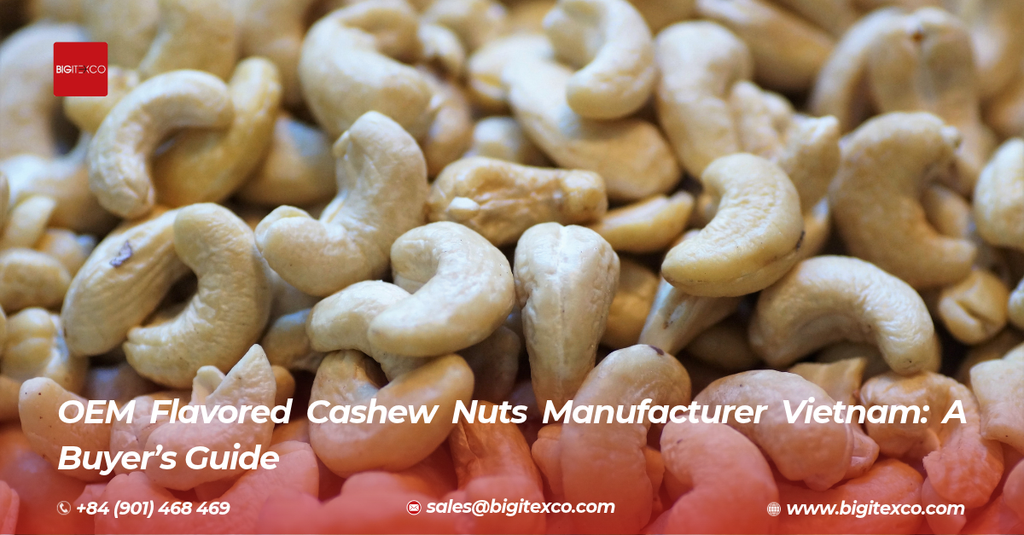
Vietnam is well known for cashew processing, but international buyers are increasingly looking for more than standard raw kernels. Retailers, distributors and snack brands may need roasted, seasoned, coated or customized cashew products developed specifically for their market.
Choosing the right OEM flavored cashew nuts manufacturer Vietnam therefore involves evaluating not only price and production capacity, but also product-development capability, food safety, ingredient control, packaging and consistency.
A reliable OEM programme should take a product from initial concept through sampling, specification approval, production and final private-label packing.
Summary
An OEM flavored cashew supplier should be able to work with the buyer on cashew grade, roasting level, flavor profile, coating, ingredients, packaging and product specification before mass production.
Buyers should request samples, confirm food-safety and allergen requirements, approve the final formulation and packaging, and agree on measurable quality standards before placing a commercial order.
In this article
- What is OEM flavored cashew production?
- What products can be customized?
- How does product development work?
- What should buyers specify for flavor and coating?
- What food-safety requirements should be checked?
- What packaging can be customized?
- What should buyers confirm before mass production?
- How should buyers choose an OEM cashew manufacturer?
1. What Is OEM Flavored Cashew Production?
OEM production allows a buyer to sell cashew products developed and manufactured according to its own requirements rather than purchasing only the supplier’s standard products.
Depending on the project, customization may include the cashew grade, roasting process, seasoning, coating, ingredient formulation, pack size, artwork and branding.
For example, one customer may need lightly salted roasted cashews in 250 g retail pouches, while another may require chocolate-coated cashews, spicy seasoning or a customized crispy coating.
OEM production is particularly useful for retailers, importers and food brands that want to create a differentiated product without operating their own cashew-processing facility.
2. What Flavored Cashew Products Can Be Customized?
The level of customization depends on the manufacturer’s equipment and R&D capability.
Common concepts may include roasted salted cashews, honey-flavored cashews, chili or spicy cashews, cheese-flavored products, chocolate-coated cashews and other sweet or savoury seasonings.
More specialized projects may involve an outer coating around the kernel. For example, a buyer may request a crispy cashew product using a rice-based or glutinous-rice-flour coating instead of a conventional flour-based coating.
For these projects, buyers should confirm whether the factory has suitable coating equipment and whether the formulation can be developed to achieve the desired thickness, crispness and adhesion.
The key point is that “OEM” does not automatically mean every product concept is technically possible. The manufacturer should evaluate the idea before confirming commercial production.
3. How Does OEM Cashew Product Development Work?
A good OEM project normally starts with a clear product brief.
The buyer should explain the intended market, target consumer, desired flavor, product texture, ingredient restrictions, pack size and expected positioning. If an existing reference product is available, a sample can make the development process considerably easier.
The manufacturer can then develop an initial formulation and produce trial samples. The buyer evaluates the taste, aroma, roasting level, seasoning intensity, texture and appearance and provides feedback.
Several sample rounds may be required before the product is approved.
Once the final sample is accepted, the buyer and supplier should convert the agreed concept into a written specification so that commercial production can reproduce the approved product consistently.
BIGITEXCO Note: The approved sample and written specification should work together. The sample demonstrates the expected sensory profile, while the specification defines measurable requirements.
4. What Should Buyers Specify for Flavor and Coating?
Flavor development should be more precise than simply requesting “BBQ,” “cheese” or “spicy.”
Buyers should explain the expected intensity, sweetness, saltiness and heat level, as well as any restrictions on ingredients or additives. The final recipe should also identify ingredients that may create allergen or labelling requirements in the destination market.
For coated cashews, buyers should additionally confirm the type of coating, thickness, texture and desired kernel-to-coating balance. A thin seasoning layer creates a very different product from a thick crispy shell.
Special concepts such as rice-based coatings should also define whether the buyer specifically requires rice flour, glutinous rice flour or another rice-derived ingredient.
This level of detail helps the supplier develop the correct product more quickly and reduces unnecessary sample revisions.
5. What Food-Safety Requirements Should Buyers Check?
OEM products can be more complex than ordinary cashew kernels because additional ingredients introduce additional food-safety and allergen considerations.
Depending on the formulation, buyers may need to review cashew allergens, milk, soy, gluten-containing cereals or other allergens present in seasoning and coating ingredients.
The finished product may also need to comply with destination-market requirements covering pesticide residues, contaminants, microbiology, food additives and labelling.
Buyers supplying the European market should review our EU Cashew Import Requirements guide for more information about food-safety, allergen, traceability and packaging requirements.
For international projects, the destination market should therefore be communicated to the manufacturer at the beginning of development rather than after the recipe has already been finalized.
6. What Packaging Can Be Customized?
Packaging is a major part of private-label cashew development because it affects both product presentation and shelf-life protection.
Buyers should confirm the pack size, packaging material, bag dimensions, sealing method and carton configuration before commercial production. Retail projects may also require customized artwork, barcode information, nutritional information and local-language labelling.
Common retail sizes may range from small snack packs to larger family formats, while food-service or industrial customers may prefer larger bulk packaging.
Packaging development should also consider the characteristics of the finished product. A chocolate-coated product, for example, may require different storage and packaging considerations from ordinary roasted cashews.
For long-term retail programmes, packaging compliance in the destination market should be reviewed before artwork is printed.
7. What Should Buyers Confirm Before Mass Production?
Commercial production should begin only after the main technical and commercial details have been agreed.
The final specification should cover the cashew grade, formulation, roasting level, flavor or coating, ingredient list, allergen information, net weight, packaging format, shelf life and applicable quality requirements.
The parties should also agree on the approved sample, order quantity, price, Incoterm, production schedule and required export documentation.
For new OEM products, it is usually safer to complete the sample-development and approval process before ordering large volumes of printed packaging.
This reduces the risk of having packaging ready for a formulation that still requires changes.
8. How Should Buyers Choose an OEM Cashew Manufacturer in Vietnam?
Price should not be the only factor when comparing OEM suppliers.
Buyers should evaluate whether the manufacturer has experience with roasting, flavoring, coating, product development, quality control and private-label packing. The supplier should also be able to explain its development process and provide clear product specifications.
Communication is particularly important for customized products. OEM projects often require several discussions about ingredients, samples, packaging and quality expectations before production begins.
A good supplier should be willing to identify technical limitations rather than simply agreeing to every request before testing whether the product can actually be produced consistently.
For buyers new to sourcing from Vietnam, our How to Import Cashew Nuts from Vietnam guide explains the broader supplier-selection and import process.
OEM Cashew Development at a Glance
| Stage | What Buyer & Supplier Confirm |
|---|---|
| Product brief | Concept, market and target product |
| Development | Flavor, coating and formulation |
| Sampling | Taste, texture and appearance |
| Specification | Ingredients and quality requirements |
| Packaging | Size, material and artwork |
| Approval | Final sample and specification |
| Production | Commercial manufacturing |
| Shipment | Quality check and export documents |
Conclusion
Finding the right OEM flavored cashew nuts manufacturer Vietnam requires more than finding a factory that can roast cashews.
Successful product development depends on the manufacturer’s ability to manage formulation, flavor, coating, sampling, quality control, packaging and private-label requirements consistently.
Buyers should start with a clear product concept, develop and approve samples, and then convert the final product into a measurable written specification before mass production.
At BIGITEXCO, we support international B2B customers with Vietnamese cashew products, customized specifications and OEM/private-label solutions.
Developing Your Own Cashew Product?
Frequently Asked Questions
Can flavored cashews be customized for OEM production?
Yes. Depending on the manufacturer’s capability, buyers can customize the roasting level, seasoning, formulation, coating and packaging
Can an OEM supplier develop a new flavor from a buyer’s idea?
Potentially yes. The supplier should first evaluate the concept and normally develop samples for approval before confirming mass production.
Can cashews use a rice-based coating?
Rice flour or glutinous rice flour can potentially be used in coated snack concepts, but the buyer should confirm that the manufacturer has appropriate coating and product-development capability.
Should packaging be printed before the sample is approved?
It is generally better to finalize the product formulation and approve the sample first, especially when the ingredient list or nutrition information could still change.
Related Articles
How to Import Cashew Nuts from Vietnam: A B2B Buyer’s Guide
Cashew Nut Quality Standards for Export: A Buyer’s Guide
How Cashew Nuts Are Processed for Export: Step-by-Step Guide