
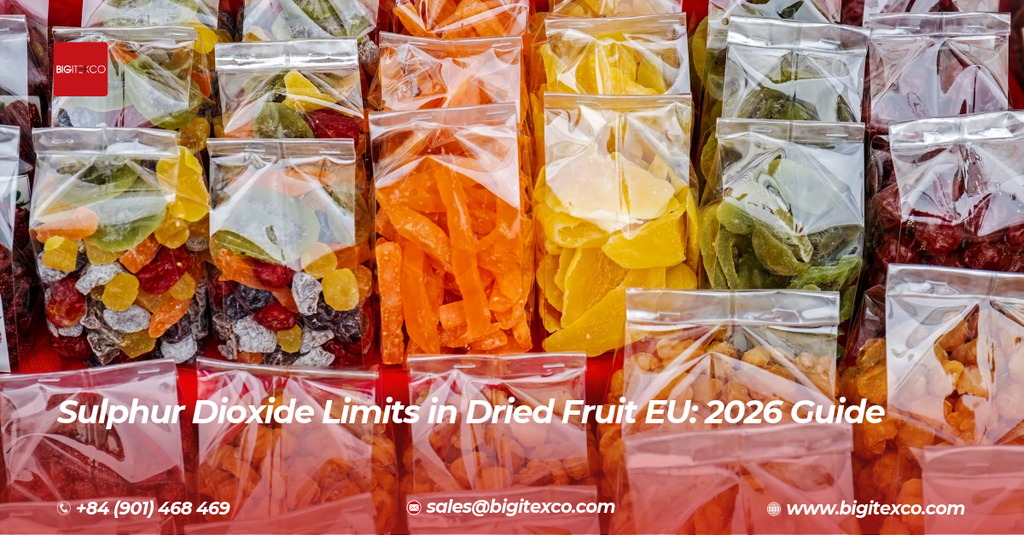
Sulphur dioxide and sulphites are commonly used in dried fruit production to help preserve colour and product stability. However, products sold in the European Union must comply with specific limits depending on the type of dried fruit.
Understanding sulphur dioxide limits in dried fruit EU is particularly important for exporters of dried mango, pineapple, banana, apricot and other tropical fruits because the permitted maximum is not the same for every product.
EU Regulation (EC) No 1333/2008 establishes the authorised use and maximum levels of sulphur dioxide and sulphites, identified as E220–E228, while EU food-information rules also require sulphites above a defined threshold to be clearly communicated to consumers.
Summary
For most dried fruits that are not specifically listed in a separate category, the EU permits sulphur dioxide and sulphites up to 500 mg/kg expressed as total SO₂. Dried mango generally falls within this category.
Different limits apply to certain fruits: dried apples and pears may contain up to 600 mg/kg, dried bananas up to 1,000 mg/kg, while dried apricots, peaches, grapes, prunes and figs may contain up to 2,000 mg/kg. These limits relate to total SO₂ from all sources, not simply the amount added during processing.
In this article
- Why are sulphites used in dried fruit?
- What are the EU sulphite limits for dried fruit?
- What limit applies to dried mango?
- What do mg/kg, ppm and total SO₂ mean?
- When must sulphites be declared on the label?
- Is the legal maximum the same as a buyer specification?
- How should exporters control SO₂?
- What should buyers include in their specification?
1. Why Are Sulphites Used in Dried Fruit?
Sulphur dioxide and sulphites can be used as preservatives during dried fruit processing. They are particularly useful for maintaining colour and improving product stability during processing and storage.
Under EU legislation, permitted sulphites include compounds identified from E220 to E228, such as sulphur dioxide and sodium metabisulphite (E223). Food additives in the EU must be specifically authorised for their intended food category and used according to the applicable conditions.
For dried mango, sulphites can help maintain a brighter yellow or golden appearance. Products made without added sulphites may naturally become darker during processing and storage, so buyers should take the formulation into account when setting colour specifications.
2. What Are the EU Sulphite Limits for Dried Fruit?
EU Regulation (EC) No 1333/2008 sets different maximum sulphite levels for different types of dried fruit.
| Product | Maximum total SO₂ |
|---|---|
| Dried coconut | 50 mg/kg |
| Other dried fruits, including dried mango* | 500 mg/kg |
| Dried apples and pears | 600 mg/kg |
| Dried bananas | 1,000 mg/kg |
| Dried apricots, peaches, grapes, prunes and figs | 2,000 mg/kg |
*The 500 mg/kg category covers dried fruit other than the specifically listed fruits above.
The important point for importers is that there is not one universal SO₂ limit for all dried fruits. The exact product category must be checked before agreeing on a specification.
3. What Sulphur Dioxide Limit Applies to Dried Mango?
Dried mango is not one of the fruits given its own higher specific limit in the EU table. It therefore generally falls within the category for other dried fruits, with a maximum sulphur dioxide and sulphite level of 500 mg/kg expressed as total SO₂. Eur-Lex
In practical terms, 500 mg/kg is numerically equivalent to 500 ppm for a solid product.
This is the regulatory maximum, however, and should not automatically become the target specification. Exporters should normally aim to control the process sufficiently below the applicable limit and also confirm any stricter customer requirements before production.
BIGITEXCO Note: A legal limit of 500 ppm does not mean every EU buyer will accept 500 ppm. A customer may require ≤300 ppm, ≤200 ppm or no added sulphites as part of its own product specification.
4. What Do mg/kg, ppm and Total SO₂ Mean?
For solid food, 1 mg/kg is equivalent to 1 ppm, so a laboratory result of 200 mg/kg total SO₂ can also be described as approximately 200 ppm.
The EU maximum levels are expressed as SO₂ and apply to the total amount available from all sources. This means compliance should be evaluated using the analytical total SO₂ result rather than only calculating how much sodium metabisulphite or another sulphite compound was added during production.
This distinction is particularly important when comparing formulations because E223, for example, is an ingredient compound, while the regulatory maximum is expressed as its equivalent total SO₂.
5. When Must Sulphites Be Declared on the Label?
Sulphur dioxide and sulphites are included among the 14 substances or products subject to EU allergen-information requirements when present above 10 mg/kg or 10 mg/L expressed as total SO₂ in the product as offered ready for consumption.
For prepacked products, allergens must be clearly identified and emphasised within the ingredient list. In addition, food additives are generally identified using their functional class followed by their specific name or E-number, according to the applicable labelling rules.
For example, where appropriate to the actual formulation, a product could identify the preservative as sodium metabisulphite (E223). The final wording and language should always be reviewed for the destination market.
6. Is the Legal Maximum the Same as a Buyer Specification?
No. This distinction is extremely important in B2B dried fruit trade.
The EU legal maximum determines whether a product can comply with the applicable regulatory limit. A buyer specification, however, may establish a considerably lower maximum based on the customer’s product positioning, retailer policy or internal quality programme.
For example, two buyers sourcing the same dried mango could request:
Buyer A: SO₂ ≤300 ppm.
Buyer B: SO₂ ≤200 ppm.
Both specifications are stricter than the general 500 mg/kg regulatory maximum applicable to dried mango.
Therefore, suppliers should never assume that meeting the EU legal limit automatically means the product meets the customer’s contract.
For a broader overview of European dried-fruit requirements, internally link this section to your EU Dried Fruit Import Requirements article.
7. How Should Exporters Control SO₂?
SO₂ management should begin during formulation and processing rather than with a laboratory test only after production has finished.
Manufacturers should control the sulphite treatment process consistently and verify finished-product results through appropriate laboratory testing. Production records should also connect the formulation, processing batch, analytical result and finished lot so that the product can be traced if a customer raises a question.
Because SO₂ levels can also influence colour and product characteristics, suppliers should agree on the SO₂ target together with moisture, colour, texture and shelf-life requirements rather than treating each parameter independently.
The Certificate of Analysis should clearly state the test result and unit, for example Total SO₂: 180 mg/kg, so that the buyer can compare the result directly with the agreed specification.
8. What Should Buyers Include in Their Dried Fruit Specification?
A good specification should state whether sulphites are intentionally added and define the maximum acceptable total SO₂ level in mg/kg or ppm. It should also identify the relevant formulation, because a sulphited dried mango and a no-added-SO₂ product may differ substantially in colour and processing characteristics.
SO₂ should be considered together with other important requirements such as added sugar, moisture, colour, texture, microbiology, pesticide residues, packaging and shelf life.
For dried mango specifically, buyers should avoid requests such as “low SO₂” because the term is too subjective. A measurable requirement such as Total SO₂ ≤200 mg/kg is much clearer for production, testing and claims handling.
For more guidance on building a complete product specification, link this section to your Dried Mango Quality Specifications for Export article.
Sulphite Limits at a Glance
| Parameter | EU / Commercial Reference |
|---|---|
| Dried mango | Generally max. 500 mg/kg total SO₂ |
| Apples & pears | Max. 600 mg/kg |
| Bananas | Max. 1,000 mg/kg |
| Apricots, peaches, grapes, prunes & figs | Max. 2,000 mg/kg |
| Dried coconut | Max. 50 mg/kg |
| Allergen declaration threshold | Above 10 mg/kg total SO₂ |
| 1 mg/kg | Approximately 1 ppm for solid foods |
| Buyer requirement | May be stricter than EU maximum |
The regulatory limits above are from the consolidated EU food-additive rules applicable in 2026.
Conclusion
Understanding sulphur dioxide limits in dried fruit EU requires more than remembering one number.
The EU permits different sulphite levels according to the dried fruit category. For dried mango, the applicable maximum generally falls under 500 mg/kg total SO₂, while certain fruits such as bananas, apricots and grapes have different limits.
Exporters should also remember that sulphites above 10 mg/kg trigger relevant EU allergen-information requirements and that buyer specifications may be considerably stricter than the legal maximum.
For international B2B trade, the safest approach is to agree on a measurable SO₂ specification before production and verify the finished lot through appropriate testing.
At BIGITEXCO, we supply Vietnamese dried fruit products and support international buyers with customized specifications, bulk supply and OEM/private-label requirements.
Looking for Dried Mango from Vietnam?
Related Articles
EU Dried Fruit Import Requirements: 2026 Compliance Guide
Dried Mango Quality Specifications for Export: A Buyer’s Guide
How Cashew Nuts Are Processed for Export: Step-by-Step Guide