
Moving through the first half of the year, the Vietnam dried fruit market H1 2026 has solidified its position as a critical node in the global agricultural supply chain., Vietnamese processors have continuously upgraded their technical compliance to fulfill the most stringent industrial orders.
Industry estimates indicate that Vietnam’s total export value for processed fruits and vegetables experienced a steady double-digit growth in H1 2026, reaching over $1.5 billion, with dried and soft-dried fruits accounting for a significant 35% of this volume.
Here is a comprehensive report on the core trends and specific data shaping the dried fruit export market in the first half of 2026.
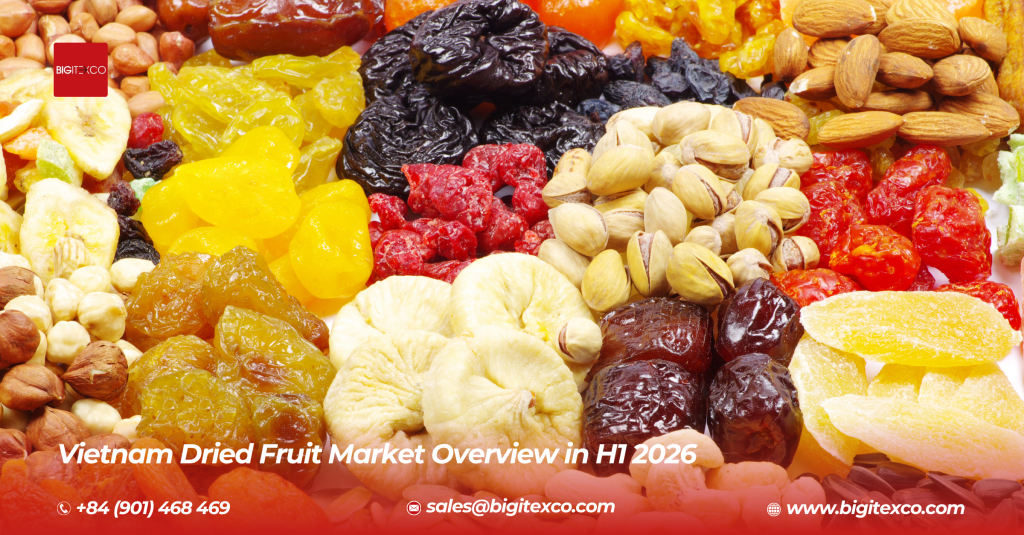
1. Vietnam Dried Fruit Market H1 2026: The Shift to “Soft-Dried”
During H1 2026, consumer preferences in key markets – particularly the EU, North America, and Northeast Asia – have shifted heavily from vacuum-fried (crispy) fruits to soft-dried fruits.
Advanced low-temperature dehydration technologies allow the products to retain up to 90% of their natural vitamins, authentic flavors, and chewy texture. The soft-dried segment recorded an estimated 18% year-over-year growth, currently capturing roughly 65% of the total dried fruit export mix. Global B2B buyers are increasingly prioritizing “no added sugar” or “low-sugar” variants (sugar content under 5%) to meet international health-conscious dietary standards.
2. Top-Performing Export Categories
The export product portfolio from Vietnam in H1 2026 highlighted massive surges in premium tropical specialties:
- Soft-Dried Mango: Remaining the undisputed leader, soft-dried mangoes accounted for over 40% of total dried fruit export volume. Thanks to abundant raw material zones and thick-fleshed varieties (like Keo mango), it remains a “must-have” SKU for international retailers.
- Soft-Dried Dragon Fruit: This category witnessed a remarkable 25% volume surge in Northeast Asian markets (such as South Korea and Japan). Its vibrant natural color and high nutritional profile make it a premium ingredient for the cereal and confectionery industries.
- Dried Jackfruit: Whether crispy or soft – dried, jackfruit maintained a stable export volume of approximately 50,000 metric tons, dominating neighboring markets and cross-border trade.
3. Technical Barriers & Strict Quality Assurance (QA/QC)
In 2026, international buyers have become extremely vigilant regarding food safety risks. To ensure smooth customs clearance in premium markets, Vietnamese suppliers must master two critical technical parameters:
- Precision Moisture Control: The ideal moisture level must be strictly maintained within a narrow range of 15% to 18%. This ensures the chewy texture remains intact without fostering mold during extended maritime transit (typically 25-35 days to EU/US ports).
- Sulfite () Residue Limits: High-end markets demand rigorously controlled levels. To pass EU and US FDA inspections, sulfite residues must remain strictly <100 ppm, requiring state-of-the-art microbiological processing technology.
Furthermore, possessing HACCP and ISO 22000 certifications is no longer a competitive advantage – it is a mandatory “passport” for Vietnamese exporters entering the global playing field.
4. The Boom in OEM & Private Label Services
A major highlight of the Vietnam dried fruit market in H1 2026 is the exponential rise in OEM (Original Equipment Manufacturer) and Private Label orders.
Data suggests that over 30% of traditional bulk-buyers have transitioned to requesting retail-ready packaging directly from the source. Instead of importing raw bulk cartons (10kg – 20kg), international supermarkets are partnering with Vietnamese factories for customized packaging solutions. Facilities capable of providing flexible options – such as 100g – 500g stand-up zipper pouches (doypacks) with bespoke brand printing—are capturing the highest profit margins in the current supply chain.
Conclusion: The Vietnam Dried Fruit Market H1 2026
The Vietnam dried fruit market in H1 2026 has demonstrated remarkable maturity in technical standardization and OEM capabilities. For global procurement teams, establishing direct partnerships with ISO 22000-certified factories – those capable of strict control and comprehensive private labeling – is the optimal strategy to secure a sustainable competitive advantage.
Are you looking to optimize your tropical fruit supply chain? Explore the Bigitexco export portfolio to connect with premium, factory-direct soft-dried fruits engineered for international standards.