
Summary
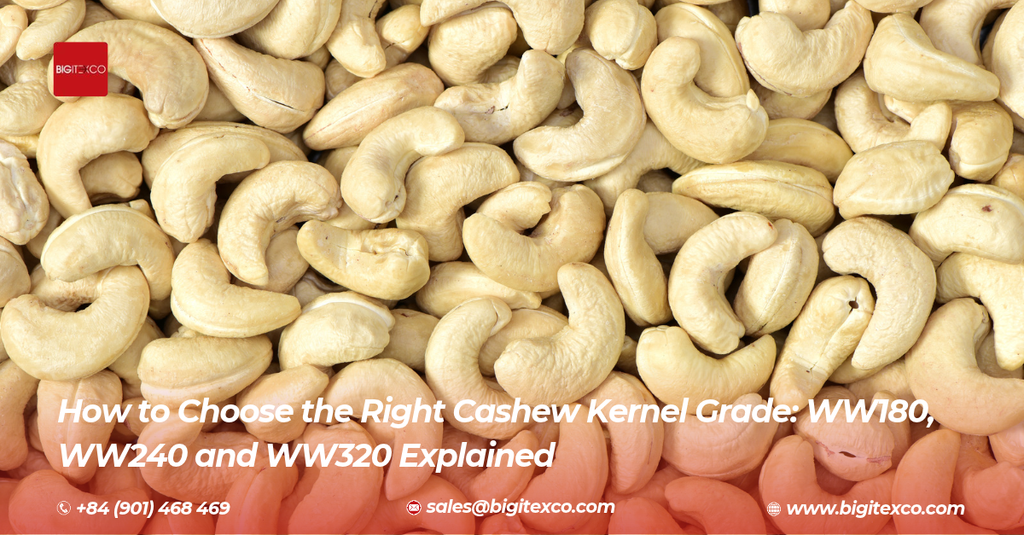
Cashew kernel grades such as WW180, WW240 and WW320 primarily indicate the size classification of white whole cashew kernels.
- WW180: Larger whole kernels, often selected for premium presentation and retail packaging.
- WW240: Medium-large whole kernels, suitable for premium snacks, wholesale distribution and food applications.
- WW320: A widely traded commercial grade, commonly considered for bulk supply, roasting, retail snacks and food manufacturing.
The right grade depends on the buyer’s intended application, appearance requirements, target price and product specification. A smaller grade is not necessarily lower quality: size and quality are separate purchasing considerations.
In this article
What Do Cashew Kernel Grades Mean?
Cashew kernels are commercially classified according to characteristics such as color, shape, size and the presence of defects.
One of the most familiar grading systems uses codes such as WW180, WW240 and WW320.
The code can be understood as follows:
- W: White
- W: Whole
- Number: Size designation based on the number of kernels per pound under the applicable grading convention.
For example, WW320 refers to white whole cashew kernels in the 320 size category.
In general, the lower the number, the larger the kernels. This is because fewer large kernels are needed to make up one pound compared with smaller kernels.
The United Nations Economic Commission for Europe (UNECE) publishes a commercial quality standard for cashew kernels, DDP-17. Its grading framework covers whole kernels and broken forms, together with requirements concerning quality and defects. The International Nut and Dried Fruit Council also provides an overview of commercial grades and forms based on this standard.
However, buyers should not assume that a grade code alone defines every quality requirement. The applicable standard, count range, tolerances and contractual specification must also be confirmed.
WW180 vs WW240 vs WW320: What Are the Differences?
The main difference between these three grades is kernel size.
Typical commercial appearance of whole cashew kernel grades
| Grade | Relative size | Common purchasing consideration |
|---|---|---|
| WW180 | Largest of the three | Premium visual presentation |
| WW240 | Medium-large | Premium and mainstream whole-kernel products |
| WW320 | Smaller | Commercial versatility and price positioning |
WW180 — Extra-Large Whole Cashew Kernels
WW180 is a larger whole-kernel grade.
Its size and visual presentation can make it suitable for:
- Premium retail snack packaging
- Gift packs and premium nut assortments
- High-end roasted cashew products
- Buyers targeting larger whole kernels
Because larger kernels are generally less numerous per pound, WW180 may command a higher price than smaller whole-kernel grades. Actual pricing depends on market conditions, quality, origin, supply and order volume.
WW240 — Large Whole Cashew Kernels
WW240 offers a balance between kernel size and commercial applications.
It can be considered for:
- Retail snack packs
- Roasted and salted cashews
- Wholesale nut distribution
- Premium food ingredient applications
For buyers who want a relatively large whole kernel without necessarily choosing the largest available grade, WW240 can be a practical option.
WW320 — Commercial Whole Cashew Kernels
WW320 is one of the familiar commercial grades in international cashew trading.
Its versatility makes it suitable for:
- Roasted and flavoured cashew products
- Retail and wholesale packaging
- Snack assortments
- Food manufacturing
- Bulk ingredient supply
For buyers purchasing larger volumes, WW320 may provide a practical balance between whole-kernel presentation, availability and purchasing cost.
The most suitable choice still depends on the required quality, specification and end product.
How to Select the Right Cashew Grade for Your Business
The best grade is not necessarily the largest one. Buyers should start with the intended use of the cashew kernels.
| Business application | Grades to consider | Main selection priority |
|---|---|---|
| Premium retail snack packs | WW180, WW240 | Larger appearance and whole-kernel presentation |
| Standard retail cashew snacks | WW240, WW320 | Consistent size and commercial value |
| Roasted and salted cashews | WW240, WW320 | Kernel integrity and roasting performance |
| Food manufacturing | WW320 and selected pieces | Ingredient cost and processing requirements |
| Nut mixes | WW240, WW320 | Appearance, size and compatibility with other ingredients |
| Premium gift products | WW180, WW240 | Visual appeal and uniform presentation |
These are general purchasing suggestions, not fixed industry rules.
For example, a manufacturer producing roasted cashews may prefer WW320 because the finished product’s commercial requirements do not justify the additional cost of a larger grade.
On the other hand, a premium gift-pack brand may prioritize WW180 or WW240 because the size and appearance of individual kernels are more important to its positioning.
Before selecting a grade, buyers should consider:
- Target market: Does the product compete in the premium, mainstream or value segment?
- Product format: Will the kernels be sold whole, roasted, seasoned or used as ingredients?
- Packaging size: Does the retail format require a particular visual appearance?
- Target purchasing price: Is the additional cost of larger kernels commercially justified?
- Customer expectations: Does the buyer have an approved reference sample or specific size requirement?
Quality Factors Beyond Kernel Size
A grade code does not guarantee that every aspect of product quality will meet the buyer’s expectations.
Two suppliers may offer WW320 cashews, but their products may differ in color, defects, moisture, handling and other quality characteristics.
Buyers should evaluate the following factors.
1. Color and appearance
White whole cashews generally have a characteristic white, ivory or light-colored appearance, depending on the applicable specification.
Check for:
- Uneven or abnormal discoloration
- Excessive black or brown spots
- Surface damage
- Excessive shrivelling
- Inconsistent appearance within the lot
2. Kernel integrity
Whole kernels should meet the agreed whole-kernel definition.
Under the UNECE DDP-17 framework, a whole kernel generally retains more than seven-eighths of its original structure. Buyers should confirm the definition and permitted broken-kernel tolerance in their purchasing specification.
3. Moisture and product condition
Moisture should be evaluated against the agreed product specification and relevant testing method.
Excessive moisture can create quality and storage concerns, while insufficient control of storage conditions may also affect product condition.
4. Flavor and odor
Cashews should have a characteristic natural flavor and odor appropriate to the product.
Check for rancidity, unusual odors or other sensory defects.
5. Defects and foreign matter
Quality inspection should cover relevant defects, including:
- Insect damage
- Mould
- Rancidity
- Foreign matter
- Excessive adhering testa
- Damaged or shrivelled kernels
The UNECE cashew standard and the Association of Food Industries (AFI) specifications provide useful references for commercial quality evaluation. Buyers should agree on which standard or specification applies to their order.
Whole Kernels vs Cashew Pieces
Not every food manufacturer needs whole cashew kernels.
Depending on the application, broken kernels and pieces may provide better purchasing value without compromising the final product.
| Product form | Description | Potential applications |
|---|---|---|
| Whole kernels | Intact kernels meeting the agreed whole definition | Retail snacks, roasted cashews and premium packaging |
| Splits | Kernels separated lengthwise | Bakery, confectionery and snack production |
| Butts | Kernels broken crosswise | Food processing and confectionery |
| Large pieces | Larger broken kernel pieces | Bakery, cereals, toppings and nut mixes |
| Small pieces | Smaller kernel fragments | Fillings, confectionery and ingredient applications |
| Baby bits | Very small kernel pieces | Certain processed food applications |
For example, a manufacturer producing cashew cookies or chocolate-coated products may not need expensive whole kernels.
Using appropriately graded cashew pieces can help control ingredient costs while meeting the product’s formulation requirements.
However, the buyer should specify the required piece size, appearance, defect tolerances and processing suitability rather than purchasing pieces based on a general description alone.
What Buyers Should Include in a Cashew Kernel Specification
A detailed specification helps prevent misunderstandings between the buyer and supplier.
When requesting a quotation, buyers should provide the following information:
| Specification | Information to confirm |
|---|---|
| Product | Raw white whole cashew kernels or another agreed product |
| Grade | WW180, WW240, WW320 or required broken grade |
| Size | Count per pound and applicable grading convention |
| Color | White, ivory or another agreed description |
| Quality class | Applicable commercial standard or buyer specification |
| Moisture | Agreed limit and testing method |
| Defects | Permitted tolerances for spots, damage, broken kernels and other defects |
| Packaging | Bulk carton, vacuum packaging or another agreed format |
| Net weight | Required net weight per carton |
| Shelf life | Supplier’s validated product specification |
| Documents | COA, product specification and other agreed export documents |
| Destination | Country and destination port |
For food manufacturers and private-label buyers, it is also important to confirm whether the cashews will be used as raw ingredients or supplied as finished roasted or flavoured products.
Roasted and flavoured cashews require separate specifications because their processing, ingredients and quality attributes differ from those of standard raw white whole kernels.
Questions to Ask Before Ordering Cashew Kernels
Before placing a bulk order, importers and distributors should clarify the following:
1. What grading standard do you use?
Ask whether the supplier follows AFI, UNECE, a national standard or a buyer-specific specification. Confirm the actual count range and tolerances.
2. Can you provide a representative sample?
A sample allows buyers to assess appearance, size, flavor and physical condition before approving a commercial shipment.
3. What is the permitted percentage of broken kernels?
Even whole-kernel grades may have an agreed tolerance for broken or lower-grade kernels. The percentage and measurement method should be written into the specification.
4. What is the packaging format?
Confirm carton net weight, inner packaging, vacuum requirements and other packing details.
5. Can you provide a Certificate of Analysis?
Request a COA showing the relevant quality and safety parameters agreed for the product.
6. Can you supply roasted or flavoured cashew products?
If the buyer needs finished snacks rather than raw kernels, clarify the available product formats, ingredients, seasoning options and packaging requirements.
7. What are the minimum order quantity and delivery terms?
Confirm the order quantity, quotation validity, production lead time, shipment schedule and agreed Incoterm.
FAQs
1. Which is bigger, WW180 or WW320?
WW180 is larger than WW320. The number refers to the size classification based on kernel count per pound, so a lower number generally represents larger kernels.
2. Is WW320 lower quality than WW180?
Not necessarily. WW180 and WW320 mainly distinguish kernel size. Overall quality also depends on color, defects, integrity, moisture, flavor and compliance with the agreed specification.
3. Which cashew grade is best for roasting?
WW240 and WW320 are both worth considering for roasted cashew products. The final choice depends on the desired appearance, product positioning, roasting process and target cost.
4. Are cashew pieces suitable for food manufacturing?
Yes. Cashew pieces are commonly used in bakery, confectionery, cereals, toppings and other food applications. Buyers should specify the required piece size and quality.
5. What does WW320 mean?
WW320 means White Whole cashew kernels in the 320 size category. The exact count range and permitted tolerances should be confirmed against the applicable grading standard and supplier specification.
6. Should buyers request samples before ordering bulk cashews?
Yes. Samples help buyers verify the product’s size, appearance, flavor and suitability for their intended application before confirming a large order.
Conclusion
Choosing the right cashew kernel grade is a commercial decision that should consider more than size.
WW180 may suit premium products that require larger whole kernels, WW240 offers a practical option for a range of retail and wholesale applications, and WW320 is a versatile commercial grade for bulk supply, roasting and food manufacturing.
For international buyers, the most reliable approach is to compare samples, confirm the grading standard, review quality specifications and calculate the overall purchasing value.
Working with a supplier that understands both product quality and the buyer’s intended application can make cashew sourcing more efficient and consistent.