
Summary
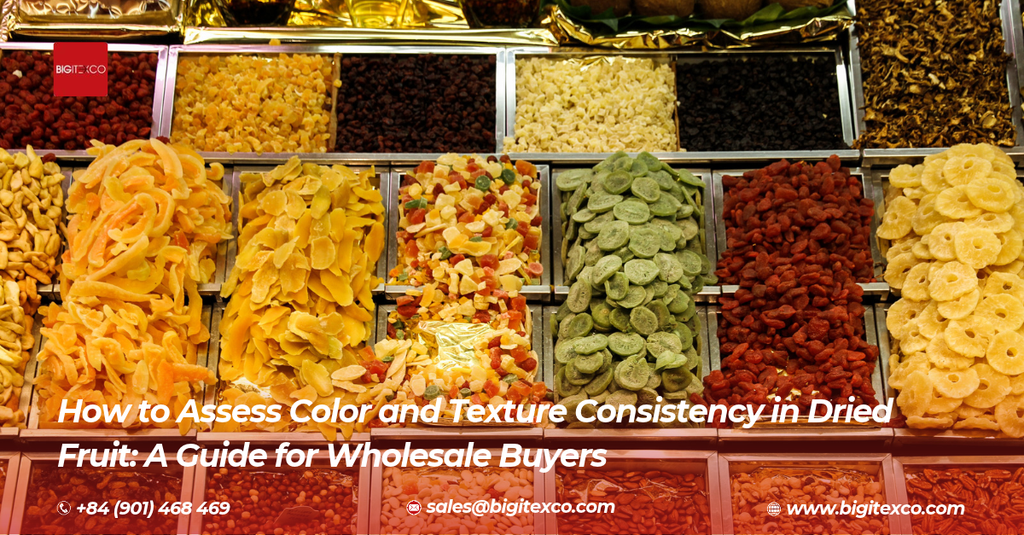
Color and texture consistency are two important indicators when evaluating dried fruit quality for wholesale purchasing and food manufacturing.
Consistent color helps maintain product appearance across retail packs and production batches, while consistent texture ensures that the product delivers the expected eating experience and performs reliably in food applications.
However, natural variations can occur because of fruit variety, maturity, drying conditions and processing methods. Buyers should therefore establish an approved reference sample, define acceptable quality ranges and use consistent inspection methods rather than expecting every piece of dried fruit to look and feel identical.
In this article
- 1. Why color and texture consistency matter
- 2. Understand natural color variations in dried fruit
- 3. How to assess dried fruit color
- 4. How to evaluate texture consistency
- 5. Understand the relationship between moisture and texture
- 6. How to compare samples and production batches
- 7. Establish quality control procedures with suppliers
- 8. What wholesale buyers should include in their specifications
1. Why Color and Texture Consistency Matter
For international importers, wholesalers and food manufacturers, product consistency is an important part of supplier evaluation.
A product may meet its basic ingredient requirements but still create commercial problems if its appearance or texture changes significantly between shipments.
Color consistency and product presentation
Color is one of the first characteristics consumers notice when purchasing dried fruit.
For retail products, inconsistent appearance can make a product look less attractive or create the impression that different batches have different quality levels.
For food manufacturers, color consistency is also important when dried fruit is used as an ingredient in:
- Breakfast cereals and granola
- Bakery products
- Snack bars
- Chocolate-coated fruit
- Confectionery
- Mixed tropical fruit products
A manufacturer may require a specific appearance so that the final product remains consistent across production runs.
Texture consistency and eating experience
Texture directly influences how consumers experience dried fruit.
For example:
- Soft dried mango should provide a pleasant, chewy texture.
- Dried pineapple should be sufficiently tender without becoming excessively hard.
- Dried banana should have a texture appropriate to its processing style.
- Dried guava should maintain the agreed balance between firmness and chewiness.
Texture also affects manufacturing performance. Pieces that are excessively sticky may clump together, while overly hard pieces may create difficulties during cutting, mixing or further processing.
Why batch consistency matters
Importers typically purchase dried fruit in commercial quantities rather than evaluating only one sample.
The product delivered in subsequent shipments should remain reasonably consistent with the approved specification and reference sample.
The Codex General Standard for Dried Fruits, CXS 360-2020, addresses colour, flavour, odour, texture and package uniformity as quality criteria.
2. Understand Natural Color Variations in Dried Fruit
One of the most important points for buyers is that natural color variation does not automatically indicate poor quality.
Different fruits have different natural pigments, sugar compositions and responses to processing.
Dried mango
Dried mango can range from yellow and golden shades to deeper amber tones.
Its final appearance may depend on:
- Mango variety
- Fruit maturity
- Initial flesh colour
- Cutting thickness
- Drying temperature and duration
- Added sugar
- Sulphite treatment, where used
- Storage conditions
For example, a product processed without sulphites may have a darker appearance than a treated product.
This does not automatically mean that the untreated product is defective.
Buyers should assess whether the colour is appropriate for the agreed product type and processing method.
Dried pineapple
Dried pineapple commonly has a natural yellow to amber appearance.
Potential concerns include:
- Excessive browning
- Unusual dark spots
- Uneven colour between pieces
- Appearance inconsistent with the approved sample
CBI’s European market guidance for dried pineapple identifies uniform natural yellow or amber colour as a common commercial quality criterion.
Dried banana
Dried banana can display different shades depending on the variety, ripeness, drying method and exposure to oxygen.
Buyers should distinguish between acceptable natural colour variation and excessive browning associated with unsuitable processing or storage.
Dried guava and dragon fruit
Dried guava can show variation in flesh colour depending on the variety and processing method.
Dried dragon fruit also requires product-specific assessment because the final appearance depends on the fruit’s original pigmentation and drying conditions.
Buyers should establish separate colour references for each fruit rather than applying the same visual standard to every product.
Important distinction: A natural darker colour is not necessarily a defect. However, mould, abnormal discolouration, suspicious spots or other signs of deterioration must not be accepted simply as natural variation.
3. How to Assess Dried Fruit Color
Color evaluation should be performed using a consistent inspection procedure.
Comparing two samples under different lighting conditions or against different backgrounds can lead to misleading conclusions.
Step 1: Establish an approved reference sample
Before placing a commercial order, buyers should approve a representative product sample.
The reference sample should reflect:
- Fruit variety and product form
- Processing method
- Ingredient composition
- Expected colour range
- Surface appearance
- General quality requirements
Photographs can support visual communication, but they should not replace a physical reference sample.
A photograph may be affected by camera settings, screen calibration, lighting and image processing.
Step 2: Use consistent lighting conditions
Inspect samples under consistent lighting conditions.
Consider:
- Neutral lighting
- A clean inspection area
- A consistent background
- Similar sample presentation
- Minimal influence from coloured surrounding objects
Avoid comparing one sample under warm indoor lighting and another under daylight.
Step 3: Evaluate the overall colour distribution
Do not examine only the most attractive pieces.
Spread out a representative sample and assess:
- Overall colour uniformity.
- Differences between individual pieces.
- Excessive browning or dark spots.
- Unusual colour changes.
- Visible surface defects.
- Similarity to the approved reference sample.
Step 4: Consider instrumental colour measurement
For buyers requiring more objective quality control, instrumental colour measurement may be useful.
A colorimeter or spectrophotometer can measure colour using the CIELAB system.
The main parameters are:
| Parameter | Meaning | Application |
|---|---|---|
| L* | Lightness, from dark to light | Compare overall brightness |
| a* | Green-to-red colour axis | Evaluate reddish or greenish tones |
| b* | Blue-to-yellow colour axis | Evaluate yellowish or bluish tones |
| ΔE | Difference between two colour measurements | Compare a sample against a reference |
For example, buyers can compare the L*, a* and b* measurements of an incoming production batch against the approved reference.
However, acceptable ΔE limits should be established for the specific fruit and application. There is no single universal colour-difference threshold suitable for all dried fruits.
Instrument readings should also be taken using consistent sample preparation and measurement conditions.
4. How to Evaluate Texture Consistency
Texture should be evaluated using both sensory inspection and, where appropriate, instrumental testing.
The preferred texture depends on the product.
Softness and chewiness
Soft dried fruit should be sufficiently flexible and pleasant to chew without becoming excessively sticky.
For soft dried mango, buyers may evaluate:
- Ease of bending
- Resistance when chewing
- Flexibility of individual slices
- Surface stickiness
- Consistency between pieces
For dried pineapple, the expected texture is generally chewable and firm without being excessively hard.
Hardness and brittleness
Excessive hardness may indicate unsuitable drying conditions, excessive moisture loss or deterioration during storage.
Brittle pieces may also be undesirable when the buyer expects a soft or chewy product.
However, hardness is not automatically a defect. Certain dried fruit products are intentionally processed to achieve a firmer or crispier texture.
The target texture must therefore be defined before production.
Stickiness and clumping
Sticky surfaces and pieces that adhere strongly to one another may create problems during packaging, transportation and further processing.
Buyers should evaluate:
- Whether pieces separate easily
- Whether excessive residue remains on the hands
- Whether pieces stick together in the package
- Whether the surface condition matches the approved sample
Some natural stickiness may be expected in certain fruit products because of their sugar content and moisture characteristics.
Instrumental texture testing
For larger manufacturers and importers, texture analysers can provide more objective measurements.
Common testing approaches include:
| Test method | What it measures |
|---|---|
| Compression test | Resistance when the sample is compressed |
| Puncture test | Force required to penetrate the fruit |
| Tensile test | Resistance to stretching or pulling |
| Cutting test | Force required to cut through the product |
| Texture Profile Analysis (TPA) | Characteristics such as hardness, springiness and cohesiveness |
These tests can help buyers compare production batches, but the results depend on sample size, temperature, testing speed, probe selection and preparation.
For reliable comparisons, the testing procedure should remain consistent.
5. Understand the Relationship Between Moisture and Texture
Moisture is one of the important factors influencing dried fruit texture.
However, moisture content alone does not completely explain how a dried fruit product feels or behaves.
Moisture content
Moisture content measures the amount of water in the product, usually expressed as a percentage by mass.
A higher moisture content may contribute to a softer texture, while excessive drying may result in harder or more brittle pieces.
Nevertheless, different fruits can have different textures at similar moisture levels.
Water activity
Water activity (aw) measures the availability of water for chemical reactions and microbial growth.
It is not the same as moisture content.
Two dried fruit products with similar moisture percentages may have different water activity values because their sugar composition, ingredients and physical structures differ.
Buyers should therefore consider both measurements when they are relevant to product stability and quality.
Why overdrying is also a problem
Lower moisture does not always mean better quality.
Excessive drying can result in:
- Harder texture
- Reduced chewiness
- Brittle pieces
- Lower product weight
- Changes in flavour and eating quality
The FAO’s technical guidance on dried fruit processing highlights the importance of reaching an appropriate drying endpoint rather than simply reducing moisture as much as possible.
Reference: FAO – Fruit and Vegetable Processing: Handling, Sorting and Storage of Dried Products.
A practical example
Consider two dried mango samples:
| Parameter | Sample A | Sample B |
|---|---|---|
| Appearance | Golden yellow | Darker amber |
| Texture | Soft and chewy | Firm and slightly hard |
| Moisture | Within agreed specification | Within agreed specification |
| Water activity | Within agreed specification | Within agreed specification |
| Overall evaluation | Matches approved reference | Requires further sensory evaluation |
Both samples may meet the same moisture specification, but they can still have different eating qualities.
This is why laboratory results should be combined with sensory and physical inspections.
6. How to Compare Samples and Production Batches
A reliable inspection should compare representative samples rather than relying on a single attractive piece or one carton.
Establish a sampling procedure
Before shipment, buyers and suppliers should agree on an inspection procedure.
It should specify:
- Number of cartons to inspect
- Method of carton selection
- Number of pieces to examine
- Inspection parameters
- Acceptance criteria
- Documentation and reporting method
For larger shipments, a recognised sampling approach may be selected according to the contract and inspection requirements.
The Codex General Standard for Dried Fruits includes provisions for package uniformity, defects and lot acceptance.
Compare three levels of consistency
1. Within the same package
Check whether the pieces have reasonably consistent colour, size and texture.
2. Between different cartons
Compare samples taken from different cartons to identify possible packaging or production variations.
3. Between production batches
Compare the current batch with the previously approved reference sample and retained production samples where available.
Prepare a batch comparison record
A simple inspection record can include:
| Inspection item | Reference sample | Current batch | Result |
|---|---|---|---|
| Overall colour | Approved | To be assessed | Pass / Review / Fail |
| Colour uniformity | Approved | To be assessed | Pass / Review / Fail |
| Texture | Approved | To be assessed | Pass / Review / Fail |
| Piece size | Approved | To be assessed | Pass / Review / Fail |
| Moisture | Agreed limit | COA result | Pass / Review / Fail |
| Water activity | Agreed limit | COA result | Pass / Review / Fail |
| Surface condition | Approved | To be assessed | Pass / Review / Fail |
| Packaging condition | Approved | To be assessed | Pass / Review / Fail |
The acceptance decision should follow the approved specification, not an inspector’s subjective preference alone.
Document inspection results
Photographs, laboratory reports and inspection records help create traceability.
When a batch differs from the reference sample, buyers should document the specific difference and discuss it with the supplier before accepting or rejecting the shipment.
7. Establish Quality Control Procedures with Suppliers
Consistency should be managed throughout production, not only during final inspection.
Importers should discuss quality control procedures with their suppliers before confirming an order.
Raw material selection
Fruit maturity, variety and incoming raw material quality can influence the final colour and texture.
A supplier should have suitable procedures for selecting and sorting incoming fruit.
Processing control
Drying temperature, drying time, product thickness and treatment conditions can influence the finished product.
Consistent processing parameters help reduce unnecessary variations between production batches.
Sorting and grading
After drying, products should be inspected and sorted to remove unsuitable pieces.
Sorting can help control:
- Excessive discolouration
- Damaged fruit
- Abnormal shapes
- Foreign matter
- Pieces that do not meet the agreed grade
Final product inspection
Before packing, the finished product should be checked against the approved specification.
Depending on the product, this may include:
- Appearance inspection
- Sensory evaluation
- Moisture testing
- Water activity testing
- Relevant microbiological testing
- Packaging integrity checks
COA and reference sample management
A Certificate of Analysis (COA) provides analytical information about a production lot.
However, a COA does not normally replace visual and sensory inspection.
Buyers should review laboratory results alongside the reference sample and inspection report.
For additional guidance, see BIGITEXCO’s article:
[How to Read a Dried Fruit Certificate of Analysis (COA)] – Link to the COA article.
8. What Wholesale Buyers Should Include in Their Specifications
A clear technical specification helps prevent disagreements between suppliers and buyers.
Rather than using general descriptions such as premium colour or soft texture, define the product requirements in a measurable and practical way.
Colour requirements
Specify:
- Expected natural colour range
- Acceptable variation
- Unacceptable discolouration
- Reference photographs
- Physical reference sample
- Instrumental colour requirements, if applicable
Texture requirements
Specify:
- Target texture: soft, chewy, firm or crispy
- Acceptable flexibility
- Hardness or brittleness requirements
- Surface stickiness
- Piece separation characteristics
- Instrumental testing requirements, if applicable
Physical and chemical specifications
Also establish:
- Product form and cut size
- Moisture range
- Water activity limit, where relevant
- Ingredient declaration
- Added sugar requirements
- Sulphite requirements
- Relevant microbiological criteria
- Defect tolerances
Packaging and commercial requirements
Confirm:
- Inner packaging material
- Net weight per bag and carton
- Export carton specifications
- Storage conditions
- Destination market
- Inspection requirements
- COA requirements
- Shipment and delivery schedule
Final buyer checklist
- Approve a representative physical reference sample.
- Define acceptable colour variation.
- Define the target texture.
- Agree on moisture and water activity specifications.
- Specify acceptable defect levels.
- Establish sampling and inspection procedures.
- Review the supplier’s COA.
- Compare production batches with the approved reference.
- Retain inspection records and relevant photographs.
- Confirm packaging and storage requirements.
Frequently Asked Questions (FAQs)
1. Why does dried fruit have different colours between batches?
Colour can vary because of fruit variety, maturity, drying conditions, processing methods and storage. Some variation is natural, but excessive browning, unusual spots and abnormal discolouration should be investigated.
2. Does darker dried mango mean lower quality?
Not necessarily. Dried mango without sulphite treatment may have a darker appearance than treated products. Buyers should evaluate the colour against the agreed product specification, ingredients and processing method.
3. How can buyers assess dried fruit texture?
Buyers can use sensory evaluation to assess softness, chewiness, hardness, flexibility and stickiness. Instrumental methods such as compression, puncture and Texture Profile Analysis can provide additional objective information.
4. Is higher moisture content always better for soft dried fruit?
No. Higher moisture does not automatically mean better texture. Product quality depends on the relationship between moisture, water activity, ingredients and processing conditions. The appropriate specification should be established for each product.
5. What is the difference between moisture content and water activity?
Moisture content measures the total amount of water in a product, while water activity measures how available that water is. Both can be useful when evaluating dried fruit quality and stability.
6. Can a COA confirm that dried fruit has consistent colour and texture?
Not completely. A COA can report analytical parameters such as moisture and water activity, but visual appearance and sensory texture generally require separate inspection.
7. Should importers approve a physical sample before placing a bulk order?
Yes. An approved physical sample provides a practical reference for colour, texture, cut size and general appearance. It can also help reduce disagreements during subsequent production and shipment inspections.
8. How can suppliers maintain consistency between production batches?
Suppliers can improve consistency through raw material selection, controlled drying conditions, sorting and grading, final product inspection, laboratory testing and comparison with approved reference samples.
Conclusion
Color and texture consistency are essential considerations when sourcing dried fruit for wholesale distribution, food manufacturing and private-label products.
Natural variations are expected, but buyers should be able to distinguish acceptable differences from quality defects.
The most reliable approach combines an approved reference sample, consistent inspection conditions, suitable laboratory testing and clear contractual specifications.
For international buyers, these measures help reduce quality disputes, improve supplier communication and support more consistent products across commercial shipments.
At BIGITEXCO, understanding product appearance, texture and technical specifications is an important part of discussing dried fruit requirements with international buyers.