
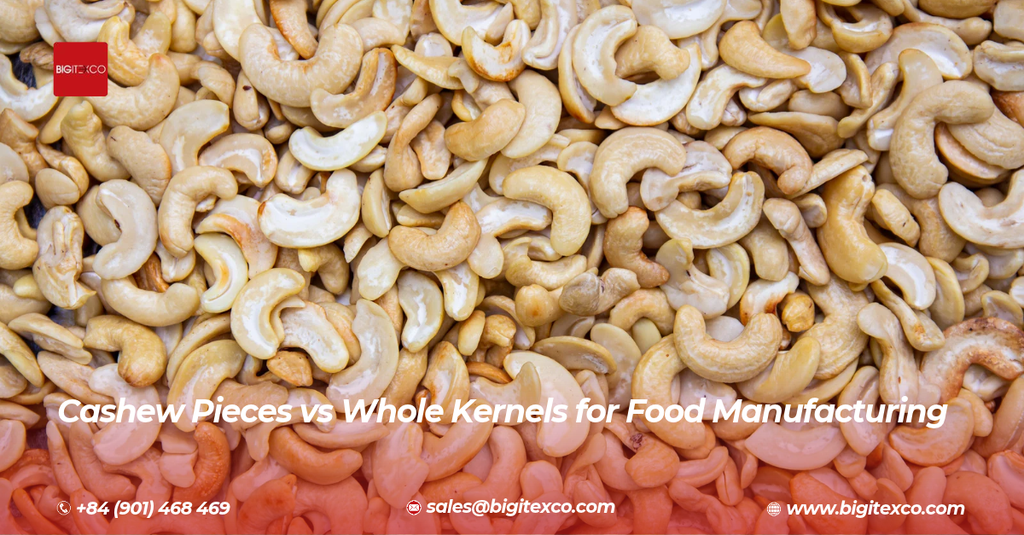
Cashew kernels are used in a wide range of food products, from premium roasted snacks to chocolate, biscuits, cereals and confectionery. However, manufacturers do not always need whole kernels. In many recipes, cashew pieces can provide the required flavour and texture while making ingredient preparation more convenient.
The decision between whole kernels and pieces depends on the finished product, production process, visual presentation and purchasing budget.
Summary
Whole cashew kernels are generally better suited to premium snack products, retail packs and applications where the intact shape matters. Cashew pieces are often more practical for chocolates, bakery products, cereals, fillings and other formulations where the kernels will be mixed, chopped or incorporated into a recipe.
In this article
- Understanding Whole and Broken Cashew Grades
- Whole Cashew Kernels: Applications and Advantages
- Cashew Pieces: Types and Commercial Applications
- How to Choose the Right Format
- Cost and Production Considerations
- Quality Specifications and Food Safety
- Sourcing and Packaging Considerations
- FAQs, Conclusion and Request a Quotation
1. Cashew Pieces vs Whole Kernels
The two formats come from the same edible cashew kernel but differ in physical condition and commercial presentation.
| Factor | Whole cashew kernels | Cashew pieces |
|---|---|---|
| Physical form | Intact kernel shape | Broken or smaller kernel portions |
| Visual presentation | More attractive for whole-nut products | Suitable for visible inclusions and mixed ingredients |
| Common applications | Roasted snacks, coated cashews, retail packs | Chocolate, biscuits, cereals, fillings and toppings |
| Processing | Can be sold directly or further processed | Ready for applications requiring smaller pieces |
| Size specification | Commonly graded by count per pound | Defined by piece category and size specification |
| Purchasing consideration | Appearance, whole-kernel integrity and size | Particle size, consistency and proportion of fines |
| Best selection factor | Product presentation | Recipe and production requirements |
2. Understanding Whole and Broken Cashew Grades
Before comparing applications, buyers should understand how whole and broken cashews are classified.
The United Nations Economic Commission for Europe (UNECE) revised its Standard DDP-17 for cashew kernels in 2023. It defines different commercial styles according to the proportion of the original kernel that remains intact.
Under this standard:
- Whole: More than seven-eighths of the kernel remains intact. A kernel with no more than one-eighth broken off is still considered whole.
- Butts: Pieces broken crosswise, retaining at least three-eighths of a whole kernel, with the cotyledons still naturally attached.
- Splits: Kernels naturally split lengthwise, with no more than one-eighth broken off.
- Pieces: Kernels that have broken into more than two pieces.
These definitions are useful when buyers compare supplier specifications and inspect incoming goods.
Understanding whole-kernel size codes
Whole cashews are commonly sold under size designations such as W180, W240 and W320. The number refers to the maximum number of kernels per pound under the relevant grading specification.
| Commercial grade | Maximum count per pound | General description |
|---|---|---|
| W180 | 180 | Larger whole kernels |
| W240 | 240 | Medium-to-large whole kernels |
| W320 | 320 | Common commercial whole-kernel grade |
| W450 | 450 | Smaller whole kernels |
The exact grade designation and applicable tolerances should be confirmed in the agreed specification. Whole-kernel count codes should not be confused with the size classifications used for broken pieces.
3. Whole Cashew Kernels: Applications and Advantages
Whole cashew kernels are particularly suitable for products where appearance, shape and consumer presentation are important.
Roasted and flavoured cashews
Whole kernels are commonly used for natural, salted, roasted and flavoured snack products. Their intact appearance makes them suitable for retail packaging and premium snack ranges.
Manufacturers developing honey-coated, chilli, barbecue or chocolate-coated cashews may also prefer whole kernels when the finished product is designed to showcase individual nuts.
Retail snack packs
Whole cashews are a practical option for:
- Premium nut snack pouches.
- Gift boxes and mixed-nut assortments.
- Portion-controlled retail packs.
- Private-label roasted cashew products.
In these applications, kernel size, colour, shape and breakage levels can influence the perceived quality of the finished product.
Visible inclusions and toppings
Whole kernels or large halves may also be used when a manufacturer wants a clearly recognisable cashew topping on a finished product.
However, if the recipe requires chopping or grinding the kernels before use, purchasing whole cashews may introduce an additional processing step.
The key advantage of whole kernels is therefore not simply their size. It is their suitability for applications where intact appearance and presentation have commercial value.
4. Cashew Pieces: Types and Commercial Applications
Cashew pieces are broken kernel portions used in food manufacturing where a whole-kernel appearance is unnecessary.
They can be incorporated into recipes directly or processed further, depending on the required ingredient size.
The UNECE DDP-17 standard identifies several piece categories using sieve apertures:
| Piece category | UNECE sieve-aperture reference |
|---|---|
| Large pieces | 4.75 mm |
| Small pieces | 2.80 mm |
| Very small pieces | 2.36 mm |
| Baby bits or granules | 1.70 mm |
These references should be read alongside the complete standard and the buyer’s agreed size specification. Commercial terminology and grading systems can differ, so buyers should request the actual size distribution rather than relying on a grade name alone.
Chocolate and confectionery
Cashew pieces can be incorporated into chocolate bars, pralines, confectionery fillings and other sweet products. Smaller pieces can be distributed throughout a mixture more easily than intact kernels.
Bakery products
Common applications include:
- Cookies and biscuits.
- Cakes and fruit cakes.
- Pastries and bakery fillings.
- Cashew toppings and inclusions.
Cereals and snack products
Cashew pieces can be added to granola, breakfast cereals, snack bars and nut-based blends. Their size should be selected to match the intended eating experience and production equipment.
Ice cream and desserts
Diced cashews and smaller pieces can be used as toppings or inclusions in ice cream and dessert products.
Sauces and prepared foods
Smaller cashew formats or cashew meal can be incorporated into selected sauces, curry formulations and prepared foods where a finer texture or thicker consistency is required.
The International Nut and Dried Fruit Council’s technical information guide identifies applications for whole kernels and pieces across snacks, bakery, confectionery, cereals, sweets and ice cream.
5. How to Choose the Right Format for Your Product
The most effective way to select cashew kernels is to start with the finished product rather than the raw ingredient price.
| Manufacturing application | Suggested format | Main reason |
|---|---|---|
| Roasted cashew snacks | Whole kernels | Intact appearance |
| Chocolate-coated cashews | Whole kernels | Product presentation |
| Chocolate bars | Pieces | Easier incorporation into chocolate |
| Cookies and biscuits | Pieces | Consistent distribution in dough |
| Cakes and pastries | Pieces or large pieces | Flexible toppings and inclusions |
| Granola and cereals | Pieces or diced cashews | Ingredient distribution |
| Ice cream toppings | Pieces or diced cashews | Controlled topping size |
| Cashew paste or butter | Suitable kernels or meal | Further grinding and processing |
The table provides general guidance. Actual selection should account for equipment, recipe design and the required finished texture.
Three questions to ask before choosing:
- Will consumers see the cashew as a whole nut in the finished product?
- Does the production process require a specific particle size?
- Will the cashew undergo further chopping, grinding, roasting or coating?
If the product requires intact nuts, whole kernels are the logical starting point. If the cashew will be mixed into a recipe or processed into smaller particles, pieces may be more practical.
6. Cost and Production Considerations
The price difference between whole cashews and pieces is an important purchasing consideration for manufacturers.
Cashew pieces are often more economical than comparable whole-kernel grades because they do not provide the same intact appearance. However, actual price differences depend on piece size, quality class, colour, availability, origin, processing and market conditions.
Buyers should compare more than the quoted price per kilogram.
Consider the total ingredient cost
For a manufacturing operation, the total cost can include:
- Raw material purchase price.
- Additional chopping or grinding.
- Labour and equipment requirements.
- Handling losses and rejected material.
- Sorting and quality-control costs.
- Production efficiency.
For example, a biscuit manufacturer may find that purchasing pre-sized cashew pieces reduces preparation time compared with buying whole kernels and chopping them internally.
However, a manufacturer producing premium roasted cashew snacks may need whole kernels to achieve the intended appearance. In that case, using pieces simply because they have a lower purchase price would not meet the product requirement.
Control particle-size variation
A mixture containing inconsistent sizes can affect the finished product. Very small particles may accumulate at the bottom of packaging or distribute differently during mixing, while oversized pieces may not suit automated dosing equipment.
A clear size specification and an agreed tolerance for fines can help reduce these problems.
Request quotations for both formats
For manufacturers using significant quantities of cashews, it can be useful to compare quotations for whole kernels and pieces against the same delivery terms, packaging basis and quality requirements.
This provides a more meaningful comparison than looking at headline prices alone.
7. Quality Specifications and Food Safety
Whole kernels and pieces should both be evaluated for food safety, freshness and suitability for the intended application.
A lower-priced piece grade should not be assumed to have lower food safety requirements.
Key quality parameters
Buyers should consider:
- Colour and acceptable visual variation.
- Characteristic cashew flavour and aroma.
- Moisture content.
- Foreign matter and shell fragments.
- Insect damage and visible mould.
- Rancidity and deterioration.
- Kernel or piece-size distribution.
- Packaging condition and lot traceability.
Understanding the UNECE standard
The 2023 UNECE DDP-17 standard specifies a maximum moisture content of 5.0% for cashew kernels within its scope. It also establishes quality classes, minimum requirements and tolerances.
Importantly, DDP-17 explicitly excludes kernels that have been roasted, salted, sugared, flavoured or oil-fried, as well as kernels intended for industrial processing. Therefore, buyers purchasing ingredient-grade cashews or processed snack products should establish an appropriate contractual specification rather than assuming the standard automatically covers every product.
Food safety documentation
Depending on the destination market and buyer requirements, importers may request:
- Lot-specific Certificate of Analysis (COA).
- Microbiological test results.
- Chemical contaminant and pesticide-residue information, where applicable.
- Allergen and ingredient declarations.
- Traceability and production records.
- Packaging and storage specifications.
Cashews are tree nuts and should be handled and labelled according to applicable allergen requirements in the destination market.
The buyer and supplier should agree on testing methods, acceptance criteria and sampling procedures before shipment.
8. FAQs, Conclusion and Request a Quotation
Frequently Asked Questions
1. Are cashew pieces the same quality as whole cashews?
Not necessarily in appearance or commercial grade, but broken pieces can still be suitable, sound and food-grade ingredients. Quality depends on the agreed specification, including colour, freshness, size, defects and food safety requirements.
2. Which cashew grade is commonly used in food manufacturing?
There is no single grade for every application. Whole kernels may be selected for coated snacks and visible toppings, while pieces are often more practical for chocolate, biscuits, cereals and fillings.
3. What is the difference between W320 and cashew pieces?
W320 is a whole-kernel size designation based on count per pound. Cashew pieces are classified by their broken form and size specification. These are different grading systems and should not be compared as equivalent grades.
4. Are cashew pieces cheaper than whole kernels?
They are often less expensive than comparable whole-kernel grades, but the actual difference depends on piece size, quality, availability and market conditions. Buyers should compare quotations for the exact specifications required.
5. Can cashew pieces be used for roasting?
Yes, depending on the piece size, processing equipment and intended finished product. Buyers should confirm whether the supplier can provide pieces suitable for the required roasting and seasoning process.
Conclusion
Both whole cashew kernels and cashew pieces play important roles in the food manufacturing industry.
Whole kernels are suitable for premium snack products, coated cashews and applications where intact appearance matters. Pieces are practical for chocolate, bakery, cereals, confectionery and other formulations where the cashew is incorporated into a recipe.
For importers and manufacturers, the best purchasing decision comes from matching the kernel format to the production process, defining measurable size and quality requirements, and comparing the total ingredient cost.
Looking for a reliable supplier of cashew kernels from Vietnam?
Suggested Related Articles and Internal Links
- Roasted Cashew vs Raw Cashew: Which Is Better for Wholesale Buyers?
- How to Evaluate a Dried Fruit Supplier in Vietnam: A Practical Guide for Importers