
Summary
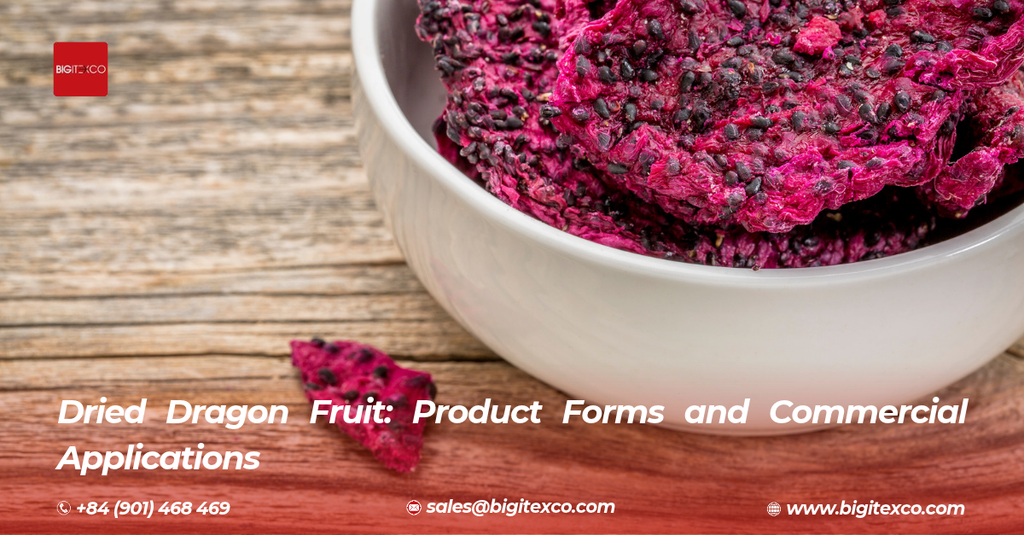
The right dried dragon fruit format depends on the intended application. Soft-dried slices are suitable for chewy fruit snacks, freeze-dried pieces offer a crisp texture for snack and cereal applications, while powder can be incorporated into selected dry mixes, beverage formulations and food products.
In this article
1. Dried Dragon Fruit at a Glance
Dried dragon fruit, also known as dried pitaya or pitahaya, is a value-added fruit ingredient used in snack products, cereals, confectionery, bakery and selected beverage applications.
Its commercial appeal comes from its distinctive appearance, edible black seeds and naturally coloured flesh. Depending on the fruit variety and processing method, dried dragon fruit can be supplied as soft-dried slices, freeze-dried pieces, cubes or powder.
| Key factor | What buyers should consider |
|---|---|
| Fruit varieties | Red-flesh and white-flesh dragon fruit, subject to availability |
| Main product forms | Soft-dried slices, freeze-dried pieces, cubes and powder |
| Texture | Soft and chewy, crisp or finely powdered |
| Colour | Natural red, pink, purple or pale flesh tones, depending on variety and processing |
| Main applications | Retail snacks, cereals, bakery, confectionery and beverage formulations |
| Ingredients | Fruit content, added sugar, preservatives and any powder carriers |
| Quality checks | Colour, flavour, texture, moisture, water activity and microbiological quality |
| Purchasing formats | Bulk ingredient packaging or retail-ready packaging, depending on supplier capability |
2. Understanding Dried Dragon Fruit Varieties
Dragon fruit is available in different varieties, commonly distinguished by their external appearance and flesh colour. For commercial processing, the distinction between red-flesh and white-flesh fruit is particularly relevant.
Red-flesh dragon fruit
Red-flesh dragon fruit is valued for its distinctive pink, red or purple appearance. Its colour is associated with naturally occurring betacyanin pigments. When processed into dried products, the final colour depends on the fruit variety, maturity, processing conditions and storage.
Potential applications include:
- Colourful dried fruit snack products.
- Freeze-dried fruit toppings.
- Cereal and granola inclusions.
- Fruit powder for selected food formulations.
White-flesh dragon fruit
White-flesh dragon fruit has a pale interior with characteristic small black edible seeds. Its appearance is more subtle than that of red-flesh varieties.
Potential applications include:
- Mixed dried fruit products.
- Soft-dried fruit snacks.
- Cereal and bakery inclusions.
- Fruit-based ingredient blends.
The two varieties should not automatically be treated as interchangeable. Their colour, flavour profile and appearance can produce different results in the finished product.
A scientific study published in Foods in 2023 examined dragon fruit varieties and compared several drying methods. It discusses the relationship between fruit characteristics, processing and final colour and texture. This supports the importance of evaluating the actual dried sample rather than relying only on the fresh fruit’s appearance. Source: Foods, 2023.
3. Main Commercial Forms of Dried Dragon Fruit
Dried dragon fruit can be processed into different formats to meet the requirements of retail brands and industrial food manufacturers.
1. Soft-dried slices
Soft-dried slices retain a chewy texture and recognisable fruit shape. They are suitable for businesses looking to offer dried dragon fruit as a direct snack or as part of a mixed fruit assortment.
Potential applications:
- Retail dried fruit packs.
- Mixed tropical fruit snacks.
- Foodservice snack portions.
- Fruit assortments and gift products.
Buyers should confirm slice dimensions, thickness, texture, moisture requirements and whether the product contains added sugar or other ingredients.
2. Freeze-dried slices and pieces
Freeze-dried dragon fruit is produced using a low-temperature dehydration process under reduced pressure. The resulting product is generally porous, lightweight and crisp.
It may be supplied as slices, cubes or smaller pieces, depending on the processor’s equipment and specifications.
Potential applications:
- Premium dried fruit snacks.
- Breakfast cereals and granola.
- Chocolate and confectionery inclusions.
- Dessert toppings.
- Snack mixes.
Because freeze-dried products are fragile and can absorb moisture, buyers should pay particular attention to breakage levels, moisture protection and packaging integrity.
3. Dragon fruit powder
Dragon fruit powder is a finely processed ingredient that can be incorporated into selected food formulations.
Potential applications include:
- Smoothie and beverage powder blends.
- Bakery and dessert mixes.
- Confectionery formulations.
- Dry ingredient blends.
- Colour-oriented food product development.
An important purchasing consideration is the ingredient composition. Some fruit powders are made with carriers or processing aids to support drying and powder handling. A 2024 study on red dragon fruit powder, for example, evaluated freeze-drying and spray-drying approaches and used ingredients such as whey protein isolate and maltodextrin in its experimental formulations. Buyers should therefore confirm whether a commercial powder is 100% fruit or contains additional ingredients. Source: Transactions of the Chinese Society of Agricultural Engineering, 2024.
Not every processor offers all three formats. Importers should confirm product availability and minimum order requirements before developing a purchasing plan.
4. How Processing Methods Affect Dried Dragon Fruit Quality
The drying process has a direct influence on the appearance, texture and functional characteristics of the finished product.
Different processing methods should not be compared solely on the basis of price. Buyers need to consider what characteristics matter most for their intended application.
| Processing approach | Typical product characteristics | Potential commercial fit |
|---|---|---|
| Hot-air drying | Can produce a firmer or softer dried texture depending on process conditions | General dried fruit snacks and ingredients |
| Vacuum drying | Product characteristics depend on temperature, pressure and process design | Selected dried fruit applications |
| Freeze-drying | Generally porous, lightweight and crisp | Premium snacks, toppings and cereal inclusions |
| Spray-drying | Produces powder from a liquid fruit feed, often requiring formulation considerations | Beverage and dry ingredient blends |
| Refractance window drying | A drying technology studied for retaining certain quality attributes | Potential alternative for processed fruit ingredients |
A 2023 research study compared refractance window, hot-air, vacuum and freeze-drying methods for dragon fruit slices and pulp. The researchers observed differences in quality attributes, including colour, texture and measured phenolic content. These findings demonstrate that drying technology can influence the final product; they do not establish one universally best method for every commercial application.
For importers, the practical approach is to evaluate the finished sample against the product specification rather than selecting a supplier based only on the name of its drying technology.
5. Commercial Applications of Dried Dragon Fruit
Dried dragon fruit offers opportunities for manufacturers developing products with distinctive tropical fruit ingredients.
Retail dried fruit snacks
Soft-dried slices and freeze-dried pieces can be considered for standalone snack products. Packaging design, colour consistency, piece integrity and texture are important factors in retail presentation.
Breakfast cereals and granola
Freeze-dried pieces and smaller fruit inclusions can add visible colour and texture to cereal products. Manufacturers should assess how the pieces behave during blending and packaging.
Bakery and confectionery
Dragon fruit pieces or powder may be incorporated into selected bakery and confectionery formulations. The correct format depends on the recipe, processing temperature and desired finished appearance.
Smoothies and beverage blends
Dragon fruit powder can be considered for dry beverage mixes and smoothie formulations. Buyers should verify its fruit content, solubility or dispersibility requirements, flavour and colour performance.
Desserts and food toppings
Freeze-dried slices, cubes or smaller pieces can be used as decorative toppings for selected dessert applications. Their crisp texture makes moisture protection especially important.
| Application | Potentially suitable format | Main consideration |
|---|---|---|
| Retail snack packs | Soft-dried slices or freeze-dried pieces | Appearance and texture |
| Granola and cereals | Freeze-dried pieces or cubes | Size consistency and breakage |
| Bakery | Pieces or powder | Recipe and processing compatibility |
| Chocolate and confectionery | Pieces or powder | Moisture and formulation compatibility |
| Smoothie blends | Dragon fruit powder | Composition and dispersibility |
| Dessert toppings | Freeze-dried slices or pieces | Crispness and moisture protection |
These are potential applications, not a guarantee that every format will perform equally well in every recipe. Production trials are recommended before approving a commercial specification.
6. How to Select the Right Dried Dragon Fruit Product
Before requesting quotations, buyers should define the product’s intended function and the technical characteristics required.
A clear purchasing brief helps suppliers recommend a suitable format and reduces the risk of receiving samples that do not match the final application.
Recommended buyer checklist:
- Fruit variety: Red-flesh or white-flesh dragon fruit.
- Processing method: Soft-dried, freeze-dried, spray-dried or another specified method.
- Product form: Slices, cubes, pieces or powder.
- Dimensions: Required length, width, thickness or particle-size range.
- Colour: Acceptable natural colour range and degree of variation.
- Texture: Chewy, crisp, brittle or powder form.
- Ingredients: Fruit percentage, added sugar, preservatives and powder carriers.
- Moisture and water activity: Target values suitable for the product and intended storage conditions.
- Packaging: Bulk bag, carton, moisture-barrier packaging or retail-ready format.
- Documentation: Product specification, COA, ingredient declaration and relevant food safety documents.
For freeze-dried products, include acceptable breakage levels and the percentage of fines. For powder, request information about particle size, carriers, moisture, water activity and the powder’s intended use.
A representative sample should be evaluated under the same conditions as the buyer’s actual production or packaging process.
7. Quality, Food Safety and Export Considerations
Product appearance alone is not sufficient to establish dried dragon fruit quality. Importers should assess physical characteristics, composition, food safety and packaging together.
Physical and sensory quality
Important checks include:
- Natural colour and acceptable colour variation.
- Characteristic dragon fruit flavour and aroma.
- Texture appropriate to the selected drying method.
- Consistent dimensions or particle size.
- Acceptable levels of broken pieces and powder fines.
- Absence of visible mould, insects and foreign matter.
Moisture and water activity
Moisture content and water activity are related but different measurements. Moisture describes the amount of water in a product, while water activity indicates how available that water is for chemical reactions and microbial growth.
The appropriate targets depend on the processing method and product format. Soft-dried pieces and freeze-dried products should not automatically be assessed against the same specification.
Food safety and regulatory requirements
For buyers importing into the European Union, the CBI’s market-entry guide for dried tropical fruit, updated on 22 January 2026, identifies several important compliance areas:
- Microbiological contaminants and hygiene controls.
- Pesticide residue limits.
- Approved additives and accurate sulphite declarations where applicable.
- Contaminants and foreign-body prevention.
- Food-contact packaging requirements.
- Product labelling, traceability and country-of-origin information.
The guide also highlights colour, taste, aroma, texture, moisture, cut style and size as relevant dried-fruit quality indicators. These are useful considerations for dried dragon fruit buyers, but the applicable legal requirements must be checked for the exact product, processing method and destination market. Source: CBI – Entering the European Market for Dried Tropical Fruit.
Packaging and storage
Dried dragon fruit needs packaging appropriate to its moisture sensitivity and intended shelf life.
For soft-dried products, packaging should protect against contamination, moisture changes and external odours. For freeze-dried pieces and powder, moisture-barrier performance is especially important because exposure to humidity can affect texture and handling.
Buyers should confirm:
- Inner packaging material and sealing method.
- Net weight and outer carton configuration.
- Batch and lot identification.
- Storage instructions.
- Shelf-life declaration supported by the supplier’s product data.
- COA and traceability documents.
Do not assume that one packaging material or storage condition is suitable for all dried dragon fruit formats.
8. FAQs, Conclusion and Request a Quotation
Frequently Asked Questions
1. What is the difference between soft-dried and freeze-dried dragon fruit?
Soft-dried dragon fruit generally has a chewy texture and more flexible structure. Freeze-dried dragon fruit is typically lightweight, porous and crisp. The two products serve different applications and should have separate technical specifications.
2. Is red dragon fruit better than white dragon fruit for commercial use?
Neither is universally better. Red-flesh fruit offers a more distinctive natural colour, while white-flesh fruit has a lighter appearance. The choice depends on the target product, visual requirements, flavour profile and buyer preference.
3. Can dried dragon fruit be used in breakfast cereals?
Yes. Freeze-dried pieces and cubes can be considered for cereal and granola applications. Manufacturers should evaluate piece size, breakage, moisture protection and compatibility with the finished product.
4. What is dragon fruit powder used for?
Dragon fruit powder can be used in selected beverage blends, smoothie mixes, bakery products, desserts and dry formulations. Buyers should confirm whether the powder contains only fruit or includes carriers and other ingredients.
5. What documents should importers request from a supplier?
Importers should request a product specification, lot-specific COA, ingredient declaration, packaging information and relevant food safety documentation. Additional tests and documents depend on the destination market and customer requirements.
Conclusion
Dried dragon fruit can serve different commercial purposes depending on its variety, processing method and final product form.
Soft-dried slices are suitable for chewy snack products, freeze-dried pieces offer a crisp option for cereals and toppings, while powder provides flexibility for selected industrial formulations.
For B2B buyers, successful sourcing begins with a clearly defined application and measurable technical specifications. Evaluating representative samples, reviewing the COA and confirming packaging requirements can help reduce quality inconsistencies and purchasing risks.
Looking for dried dragon fruit for your import, distribution or food manufacturing business?
Related Articles
- Dried Mango Cut Styles: Slices, Strips and Product Selection
- Dried Pineapple Quality: How to Evaluate Color, Texture and Moisture
- How to Evaluate a Dried Fruit Supplier in Vietnam: A Practical Guide for Importers
References
- Dadhaneeya et al. (2023), Impact of Different Drying Methods on the Phenolic Composition, In Vitro Antioxidant Activity, and Quality Attributes of Dragon Fruit Slices and Pulp, Foods, 12(7), 1387.
- Wang et al. (2024), Preparation and Quality Evaluation of Red Dragon Fruit Powder by Foam-Mat Microwave Freeze-Drying, Transactions of the Chinese Society of Agricultural Engineering, 40(6), 79–89.
- CBI (22 January 2026), Entering the European Market for Dried Tropical Fruit.