
Summary
Choose dried mango slices for visible fruit presentation, strips for convenient snack portions and chunks or dice for ingredient applications. Before ordering, confirm the dimensions, thickness, formulation, moisture requirements and acceptable proportion of broken pieces.
In this article
- Dried Mango Slices
- Dried Mango Strips
- Other Dried Mango Cut Styles
- Matching Cut Styles to Applications
- How to Define Your Product Specification
- Quality and Export Considerations
- FAQs and Conclusion
1. Dried Mango Slices: A Popular Choice for Snack Products
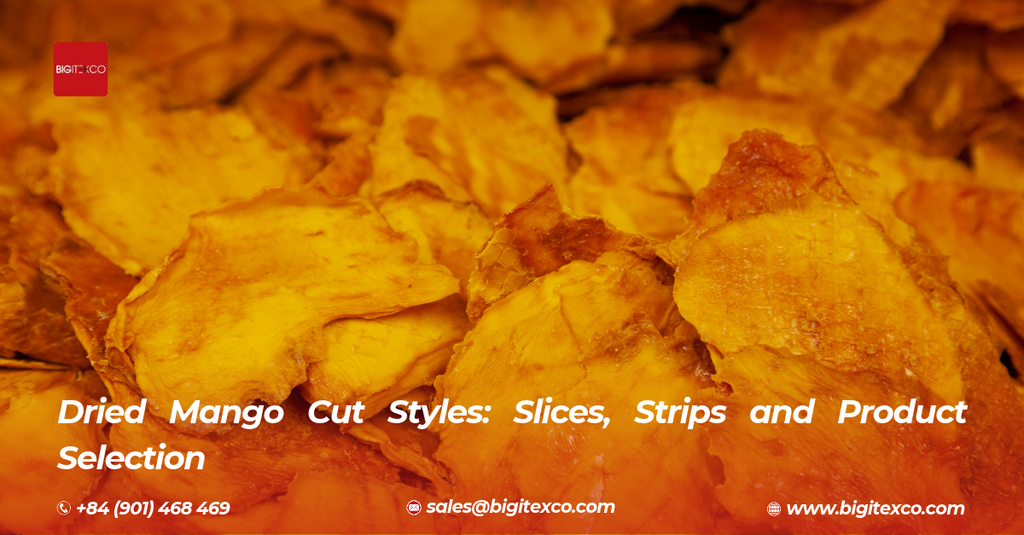
Dried mango slices are one of the most recognisable product formats. They retain a visible fruit shape and provide a convenient eating experience for consumers.
Depending on the mango variety, processing method and cutting requirements, slices can vary in length, width and thickness. Some buyers prefer larger pieces for premium retail packaging, while others prioritise consistent dimensions for portion control.
Common applications include:
- Retail dried fruit snack packs.
- Hotel and foodservice snack portions.
- Mixed dried fruit products.
- Snack assortments and gift boxes.
- Fruit toppings and selected bakery applications.
For importers selling directly to consumers, appearance and piece integrity are particularly important. Large, well-shaped slices can improve the visual presentation of a retail pack.
When requesting a quotation, buyers should clarify whether they require full slices, smaller slices or a specified size range. Avoid relying on the word “slice” alone because different suppliers may interpret the term differently.
2. Dried Mango Strips: Flexible for Snacking and Food Manufacturing
Dried mango strips are cut into elongated pieces. Compared with larger slices, they can be easier to portion, pack and incorporate into certain food products.
Strips are especially relevant to manufacturers and distributors looking for convenient snack formats or ingredients that can be combined with nuts and other dried fruits.
Common applications include:
- Individual snack pouches.
- Children’s snack products.
- Trail mixes and dried fruit blends.
- Snack bars and selected bakery products.
- Foodservice portions.
Strips also offer flexibility in product presentation. A buyer may request shorter strips for smaller retail packs or longer pieces for products where the mango itself is a visible selling point.
For accurate purchasing, specify:
- Strip length.
- Strip width.
- Thickness.
- Acceptable size variation.
- Percentage of broken or irregular pieces.
- Desired texture and formulation.
These details help suppliers prepare samples that are more representative of the final order.
3. Other Dried Mango Cut Styles
Besides slices and strips, manufacturers may offer additional formats depending on their processing equipment and production capabilities.
| Cut style | General characteristics | Potential applications |
|---|---|---|
| Half slices | Smaller portions of sliced mango | Snack packs and fruit assortments |
| Whole cheeks | Larger pieces retaining much of the mango’s original shape | Premium snack presentation |
| Chunks | Irregular or larger cut pieces | Bakery, confectionery and foodservice |
| Dice | Smaller, more uniform cubes | Granola, cereals, snack bars and bakery |
| Mango rolls | Rolled or sheet-style fruit products | Speciality snacks and confectionery |
Not every supplier offers all these formats, and the terminology can differ between producers. Buyers should request product photographs, samples and written dimensions to ensure the agreed format is clear.
For industrial applications, uniformity is often more important than appearance alone. A manufacturer using automatic dosing equipment may prefer consistently sized diced mango, while a retail snack brand may prioritise intact slices.
4. Matching Dried Mango Cut Styles to Your Application
Selecting the right cut begins with understanding how the mango will be used after delivery.
| Business application | Suggested format | Main selection priority |
|---|---|---|
| Retail dried fruit snacks | Slices or strips | Appearance and piece integrity |
| Trail mix | Strips or chunks | Convenient portion size |
| Granola and cereals | Dice or chunks | Consistent particle size |
| Bakery products | Dice or chunks | Mixing and baking performance |
| Snack bars | Strips or dice | Recipe compatibility |
| Foodservice | Slices or strips | Portion control |
| Premium fruit assortments | Large slices or whole cheeks | Visual presentation |
These are starting points rather than fixed rules. The best format depends on the recipe, packaging design, production equipment and target consumer.
For example, a snack manufacturer may prefer strips because they fit easily into individual pouches. A cereal producer may instead require diced mango to distribute fruit more evenly throughout the product.
Practical recommendation: Test the selected cut in the actual production process before confirming a large-volume order. Consider mixing performance, piece breakage, final appearance and consumer eating experience.
5. How to Define Your Dried Mango Product Specification
A clear product specification helps prevent misunderstandings between buyers and suppliers. It also makes it easier to compare quotations from different manufacturers.
Rather than requesting only “dried mango slices” or “dried mango strips,” provide a detailed purchasing brief.
Recommended specification checklist:
- Product form: Slice, strip, chunk, dice or another agreed format.
- Dimensions: Required length, width and thickness, including tolerances.
- Ingredients: 100% mango, added sugar or another agreed formulation.
- Sulphur dioxide: Whether SO₂ is permitted, restricted or required to be absent.
- Moisture and water activity: Target values appropriate to the product, process and destination market.
- Appearance: Acceptable colour range and visual defects.
- Texture: Soft, chewy, firm or another defined texture.
- Piece integrity: Acceptable percentage of broken, crushed or irregular pieces.
- Packaging: Bulk carton size, inner packaging and required net weight.
- Documentation: COA, ingredient declaration, traceability and other destination-specific documents.
The formulation deserves particular attention. Two products with the same cut style may have different ingredient compositions, sweetness levels and labelling requirements.
For example, a buyer requesting no added sugar should confirm that the supplier’s ingredient declaration and production specification match that requirement. Likewise, an SO₂ requirement should be clearly stated and verified through the agreed testing and documentation process.
6. Quality and Export Considerations
Cut style is only one part of dried mango quality. Buyers should also assess the product’s physical, chemical and microbiological characteristics.
Appearance and colour
Dried mango colour can vary with mango variety, ripeness and processing conditions. A natural colour range should be agreed with the supplier rather than judging every batch against a single ideal shade.
Request representative samples and define acceptable visual differences before production.
Texture and moisture
Texture affects both consumer experience and manufacturing performance. A softer product may suit direct snacking, while a firmer product may be more appropriate for certain ingredient applications.
Moisture content should be evaluated together with water activity and the product’s intended storage conditions. Buyers should not apply one universal moisture limit to every type of dried mango.
Defects and physical consistency
Check for:
- Excessive broken or crushed pieces.
- Inconsistent dimensions.
- Foreign matter.
- Visible mould or insect damage.
- Unusual odours or flavours.
- Unacceptable variation in colour or texture.
Food safety and destination-market requirements
The CBI’s guide to entering the European market identifies the UNECE dried mango standard as an important quality reference. It discusses defect tolerances, moisture, water activity, cut size, colour, taste, aroma and texture as relevant considerations for buyers. The guide also explains that requirements differ depending on whether products are untreated, treated with preservatives or pasteurised. CBI
UNECE also published a 2026 session document titled Standard for Dried Mangoes. Buyers developing specifications should review the relevant document and verify its status before treating it as an adopted contractual standard. UNECE+1
For export orders, importers should confirm applicable requirements for:
- Microbiological testing.
- Pesticide residues.
- Additives and sulphite declarations.
- Ingredient and nutrition labelling.
- Country-of-origin information.
- Packaging and traceability.
A lot-specific Certificate of Analysis (COA) can help buyers verify agreed parameters. It should be reviewed alongside the product specification and the destination market’s requirements.
7. FAQs, Conclusion and Request a Quotation
Frequently Asked Questions
1. What is the difference between dried mango slices and strips?
Slices are generally wider pieces that retain more of the mango’s original shape. Strips are narrower, elongated pieces that can be easier to portion and use in snack products.
2. Which dried mango cut is best for retail packaging?
Slices and strips are both suitable options. Slices can create a more substantial fruit presentation, while strips may be convenient for individual snack portions. The final choice depends on pack size, target market and product positioning.
3. Which dried mango format is suitable for food manufacturing?
Chunks and dice are often considered for cereals, granola, bakery and snack bars because they can be incorporated into recipes more easily. However, the appropriate dimensions should be tested against the manufacturer’s production process.
4. Can buyers request customised dried mango dimensions?
Some suppliers can accommodate customised cutting requirements, depending on equipment and production capabilities. Buyers should confirm the requested dimensions, tolerances and minimum order requirements before placing an order.
5. What information should importers request before purchasing bulk dried mango?
Importers should request a product specification, representative sample, ingredient declaration, COA, packaging details and relevant food safety documentation. They should also confirm cut dimensions, formulation, moisture requirements and acceptable defect levels.
Conclusion
Choosing the right dried mango cut style can influence product appearance, processing efficiency, packaging and the overall consumer experience.
Slices and strips are practical choices for snack products, while chunks and dice offer flexibility for industrial food applications. However, no single format is suitable for every business.
For international buyers, the most effective approach is to define the intended application first, establish measurable product specifications and evaluate samples before confirming bulk orders.
Looking for a reliable dried mango supplier from Vietnam?
Related Articles
- How to Evaluate a Dried Fruit Supplier in Vietnam: A Practical Guide for Importers
- Dried Pineapple Quality: How to Evaluate Color, Texture and Moisture