
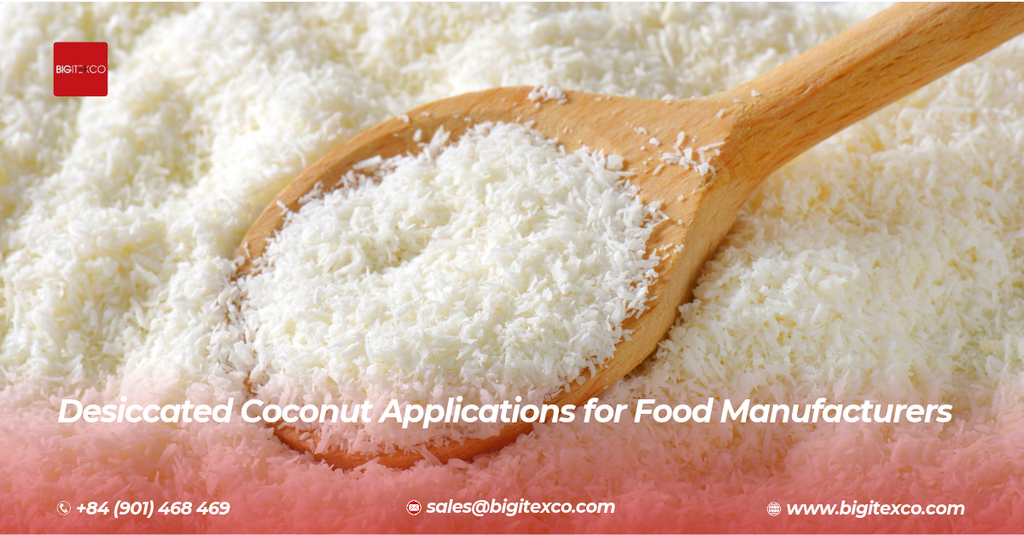
Desiccated coconut is a versatile ingredient for food manufacturers looking to add natural coconut flavour, texture and visible coconut pieces to their products. It is widely used in bakery, confectionery, snack bars, cereals, dairy products and selected savoury foods.
However, choosing the right ingredient involves more than selecting a particle size. Fat content, moisture, flavour, microbiological quality and processing compatibility can all influence the final product.
Summary
Desiccated coconut can be used as an ingredient, filling, coating, topping or inclusion in many food products. Fine grades are generally suitable for more uniform mixtures, while medium, coarse and flake forms provide more visible texture. The best choice depends on the recipe, production process and buyer specifications
Desiccated Coconut at a Glance
Desiccated coconut is made from the white kernel of mature coconuts. The kernel is cleaned, processed into the required particle size and dried to reduce moisture. It retains the characteristic flavour and oil content of coconut.
According to the Tetra Pak Coconut Handbook, desiccated coconut is commonly used in baked foods, chocolates, candies and ice cream.
| Key characteristic | What manufacturers should consider |
|---|---|
| Main ingredient | Dried coconut kernel |
| Available forms | Fine, medium, coarse, flakes, chips and other cuts |
| Fat content | Full-fat and reduced-fat options |
| Flavour | Characteristic mild coconut flavour |
| Texture | Fine particles or larger visible pieces |
| Main applications | Bakery, confectionery, snacks, cereals and prepared foods |
| Supply format | Bulk food-grade packaging, subject to supplier availability |
The ingredient can serve different functions depending on its grade and the formulation. It may contribute flavour, visible texture, coconut content or a finishing layer on the product surface.
Product Forms and Functional Differences
Food manufacturers should consider both particle size and fat content when selecting desiccated coconut. These characteristics affect how the ingredient behaves in a recipe and how it appears in the finished product.
1. Fine desiccated coconut
Fine particles are suitable for products requiring a more even distribution of coconut. Common applications include:
- Cake and biscuit mixtures.
- Chocolate and confectionery fillings.
- Smooth coconut-based coatings.
- Bakery formulations where large coconut pieces are not desired.
2. Medium desiccated coconut
Medium particles provide a more noticeable coconut texture while remaining practical for mixing and processing. They can be considered for:
- Cookies and biscuits.
- Granola and cereal products.
- Snack bars.
- Coconut toppings and fillings.
3. Coarse, flakes and chips
Larger cuts are useful when manufacturers want consumers to see and feel the coconut pieces. They can be used for:
- Product decoration.
- Chocolate and confectionery toppings.
- Granola clusters.
- Bakery finishing and garnish.
4. High-fat and low-fat options
High-fat desiccated coconut retains more of the natural coconut oil and can contribute a richer coconut character. Reduced-fat options may be more suitable when a formulation requires a lower fat contribution.
The choice should be based on the finished product’s nutritional targets, flavour profile, processing conditions and cost structure rather than assuming that one grade is suitable for every application.
Bakery and Confectionery Applications
Bakery and confectionery are among the most established markets for desiccated coconut. Its flavour and texture make it suitable for both recipes and product decoration.
Cakes and pastries
Fine or medium coconut can be incorporated into cake batters, pastry fillings and other bakery formulations. The selected particle size should match the desired crumb structure and coconut visibility.
Cookies and biscuits
Desiccated coconut can be mixed into biscuit dough to provide coconut flavour and a distinctive texture. Medium grades are worth testing when a more noticeable coconut presence is desired.
Macaroons and coconut-based sweets
Coconut is a central ingredient in many macaroon-style products and coconut confectionery. Particle size and moisture consistency are important because they influence the mixture’s handling and final texture.
Chocolate and confectionery
Manufacturers can use desiccated coconut in chocolate fillings, candy centres, coatings and toppings. Larger particles create a more visible texture, while fine grades are more suitable for uniform mixtures.
For products involving heating, baking or coating, manufacturers should test the ingredient under actual production conditions. Mixing time, moisture in the recipe and processing temperature can influence the finished result.
Snacks, Cereals and Dairy Applications
Desiccated coconut also offers opportunities for manufacturers developing convenient snacks, breakfast products and desserts.
Snack bars and energy-style bars
Coconut can be blended with dried fruits, nuts, seeds and cereal ingredients to create snack bars and bites. It contributes coconut flavour and texture while complementing ingredients such as cashews, dried mango and dried banana.
Granola and breakfast cereals
Medium coconut, flakes and chips can be incorporated into granola and cereal blends. Larger cuts are particularly useful when the product is designed to display visible ingredients.
Trail mixes and snack blends
Coconut pieces can be combined with cashews, almonds, seeds and dried fruits. Manufacturers should consider particle size and handling characteristics to help maintain a consistent blend and reduce unwanted separation.
Yogurt, ice cream and frozen desserts
Desiccated coconut can be used as a topping or inclusion in selected dairy and frozen dessert products. The manufacturer should evaluate how the ingredient behaves in the finished product, particularly its texture after contact with moisture.
These applications allow food brands to develop products with different coconut intensities, textures and ingredient combinations without changing the basic raw material category.
Savoury Foods and Prepared Meals
Although coconut is often associated with sweet products, desiccated coconut can also be used in savoury formulations.
Potential applications include:
- Curry and seasoning blends.
- Savoury coatings and crumb mixtures.
- Coconut-based fillings.
- Selected sauces and prepared-food formulations.
- Regional dishes and ready-to-cook meal ingredients.
In these applications, coconut contributes its characteristic flavour and can provide body or texture depending on the recipe.
Manufacturers should test the ingredient alongside spices, salt, oils and other components to ensure that the coconut flavour remains balanced. The required particle size may also differ between dry seasoning blends and products intended to be rehydrated or cooked.
How to Select the Right Grade for Your Product
Selecting a suitable grade starts with the role of coconut in the finished product. A manufacturer using coconut as a visible topping will have different requirements from one incorporating it into a smooth filling.
Consider these questions before requesting a quotation:
| Selection factor | Questions to clarify |
|---|---|
| Application | Will coconut be mixed, baked, coated, filled or used as a topping? |
| Particle size | Is fine, medium, coarse or flake material required? |
| Fat content | Does the formulation require full-fat or reduced-fat coconut? |
| Moisture | What moisture specification is suitable for the product and process? |
| Flavour and colour | Is a natural white to light creamy appearance required? |
| Processing | Will the ingredient undergo baking, heating, mixing or rehydration? |
| Food safety | Which microbiological and chemical tests are required? |
| Packaging | What bulk pack size and packaging material fit the production facility? |
A product specification should describe measurable requirements rather than relying only on general terms such as “premium quality” or “fine coconut.”
For example, if a manufacturer requires fine coconut with a specific fat content and moisture level, those requirements should be written into the purchasing specification and confirmed with the supplier.
Practical recommendation: Request a representative sample and test it in the actual recipe or production line before approving a large-volume order. A sample that looks suitable on inspection may behave differently during mixing, baking or storage.
Quality, Food Safety and Export Considerations
For industrial buyers, ingredient consistency and food safety are just as important as application suitability.
Key quality parameters
The Codex Standard for Desiccated Coconut, CXS 177-1991, is an important international reference. The Tetra Pak Coconut Handbook reproduces several of its composition criteria:
| Parameter | Codex reference |
|---|---|
| Moisture | Maximum 4% |
| Oil content, full-fat product | Minimum 60% |
| Oil content, partially reduced-fat product | Minimum 35%, below 60% |
| Total acidity of extracted oil | Maximum 0.3%, expressed as lauric acid |
| Ash | Maximum 2.5% |
| Foreign matter | Absent in a 100 g sample |
These figures are reference criteria, not a substitute for checking the applicable law and the buyer’s contract specification. The CBI guide to entering the European market for desiccated coconut notes that European buyers may apply tighter commercial quality expectations, including a maximum moisture level of 3%.
Microbiological control
Microbiological quality deserves particular attention. The CBI guide identifies Salmonella as an important contamination risk in desiccated coconut and explains that contamination can occur at different stages of processing, handling and storage.
Depending on the destination market and buyer requirements, importers may request laboratory results for:
- Salmonella.
- E. coli.
- Total plate count.
- Yeast and mould.
- Other specified microbiological parameters.
Testing limits and methods should be agreed with the buyer and checked against the relevant market requirements.
Packaging and storage
Bulk packaging should protect the product from moisture, contamination and external odours. Food-grade inner liners and suitable outer packaging can help preserve product quality during transportation and storage.
Manufacturers and importers should also confirm:
- Net weight and packaging format.
- Packaging material and sealing method.
- Batch identification and traceability.
- Production and expiry or best-before information, as applicable.
- Storage instructions.
- Certificate of Analysis (COA) for the relevant lot.
Desiccated coconut should generally be stored in a clean, cool and dry environment, away from direct sunlight, moisture and strong-smelling materials. Storage conditions and shelf-life declarations should follow the supplier’s validated specification and the agreed contract.
FAQs and Conclusion
Frequently Asked Questions
1. What is desiccated coconut mainly used for?
It is commonly used in bakery products, biscuits, cakes, macaroons, chocolates, confectionery, snack bars, granola, cereals, desserts and selected savoury foods.
2. What is the difference between fine and medium desiccated coconut?
Fine coconut has smaller particles and is suitable for more uniform mixtures and fillings. Medium coconut provides more visible texture and is often considered for biscuits, cereals, snack bars and toppings.
3. What is the difference between high-fat and low-fat desiccated coconut?
High-fat coconut retains a greater proportion of natural coconut oil. Reduced-fat coconut has a lower oil content, often because part of the oil has been physically extracted. The right option depends on the product formulation and nutritional requirements.
4. What specifications should importers request from a supplier?
Importers should request details of particle size, fat content, moisture, colour, flavour, microbiological parameters, packaging and applicable chemical tests. A lot-specific COA helps verify whether the delivered product meets the agreed specification.
5. Can desiccated coconut be combined with dried fruits and nuts?
Yes. It can be used in snack mixes, granola, cereal blends and snack bars alongside ingredients such as cashews, dried mango, dried pineapple and dried banana. The formulation should be tested for flavour balance, texture and ingredient distribution.
Conclusion
Desiccated coconut offers food manufacturers a flexible ingredient for developing bakery, confectionery, snack, cereal, dairy and savoury products.
The most suitable grade depends on the product application, particle size, fat content, processing method and required quality specifications. Before placing a bulk order, buyers should confirm the technical specification, review the COA and conduct a production trial.
Looking for a reliable supply of desiccated coconut from Vietnam?
Suggested Related Articles and Internal Links
- How to Evaluate a Dried Fruit Supplier in Vietnam: A Practical Guide for Importers
- Dried Pineapple Quality: How to Evaluate Color, Texture and Moisture