
Summary
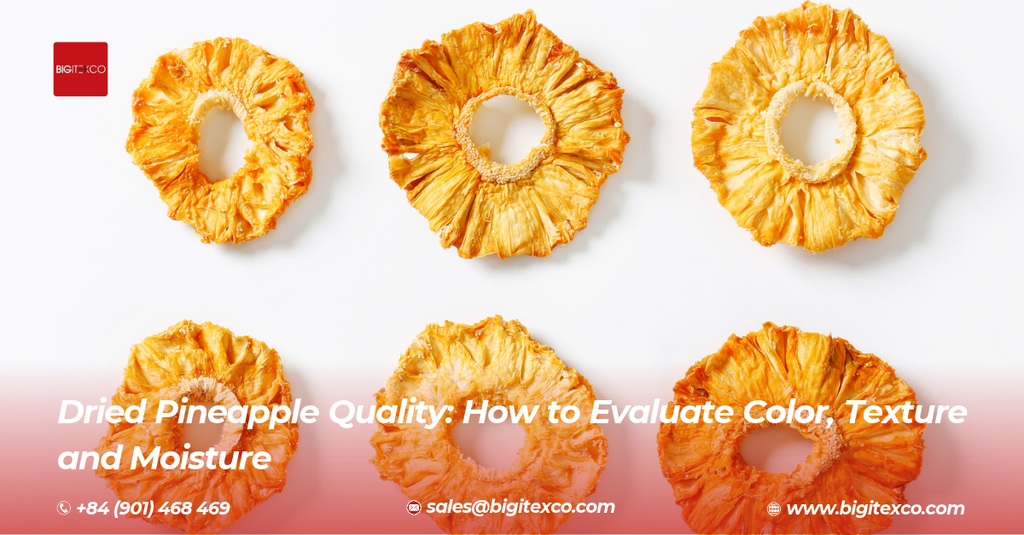
High-quality dried pineapple should have a natural, characteristic yellow-to-amber appearance, a pleasant pineapple aroma, a distinctive flavour and a texture that is easy to chew without being excessively hard or sticky.
However, colour and texture alone cannot determine whether a product meets a buyer’s specification. Moisture content, water activity, ingredients, preservatives, processing conditions and microbiological quality should also be considered.
For importers, wholesalers and food manufacturers, the most reliable approach is to establish a clear product specification, evaluate representative samples and verify important parameters through laboratory testing.
The appropriate acceptance criteria depend on whether the pineapple is naturally dried, preserved, sweetened, flavoured or processed for industrial use.
In this article
- Understanding Dried Pineapple Quality Specifications
- Evaluating Colour and Appearance
- Understanding Texture and Softness
- Moisture Content vs Water Activity
- Flavour, Aroma and Common Defects
- Processing, Additives and Food Safety
- Quality Inspection and COA Verification
- Building a Dried Pineapple Purchase Specification
1. Understanding Dried Pineapple Quality Specifications
Before evaluating colour, texture or moisture, buyers should define exactly what type of dried pineapple they intend to purchase.
Dried pineapple is available in several commercial forms, including:
- Whole slices or rings.
- Half slices.
- Broken slices.
- Spears.
- Tidbits.
- Chunks.
- Cubes.
These formats are recognised in the United Nations Economic Commission for Europe’s (UNECE) DDP-28 standard for dried pineapples.
The standard provides a useful commercial reference for quality assessment at the export control stage. It covers dried pineapple intended for direct consumption or for mixing with other products for direct consumption without further processing.
An important limitation: UNECE DDP-28 does not cover pineapple processed by sugaring, flavouring or industrial processing. Buyers sourcing these products should establish separate specifications rather than automatically applying the standard’s criteria.
The standard also identifies three optional quality classes:
- Extra Class.
- Class I.
- Class II.
These classes are associated with permitted defect tolerances. They should not be treated as universal descriptions of every supplier’s product grade.
For B2B buyers, the first step is to agree on the product form, ingredients, processing method and intended application. A dried pineapple ring for retail snacks may require different appearance and texture criteria from pineapple pieces used in bakery fillings or food manufacturing.
2. Evaluating Colour and Appearance
Colour is one of the first characteristics buyers notice when inspecting dried pineapple. It can influence consumer perception and help identify differences between production batches.
The CBI’s European market guidance describes common quality expectations for dried pineapple as a uniform natural yellow or amber colour, without noticeable spots or browning. The fruit should also have a distinctive pineapple flavour and characteristic aroma.
What good colour consistency looks like
A suitable batch should have a reasonably consistent appearance across the agreed product form and production lot.
Buyers should assess:
- Natural yellow or amber tones appropriate to the product.
- Reasonable consistency between pieces.
- Absence of pronounced dark spots or undesirable browning.
- No visible mould or unusual surface discoloration.
- A clean appearance without excessive foreign material.
What colour variations may indicate
| Appearance | Possible concern | What buyers should check |
|---|---|---|
| Excessive browning | Heat exposure, oxidation or raw-material variation | Processing history and sensory condition |
| Uneven colour | Inconsistent raw material or processing | Batch uniformity and approved reference sample |
| Very dark patches | Localised damage or deterioration | Whether the affected areas are mouldy, damaged or otherwise defective |
| Unusually bright yellow | Possible treatment or formulation differences | Ingredient declaration and sulphite test results |
| Dull or faded appearance | Processing or storage-related changes | Production records and storage conditions |
These are inspection clues, not definitive diagnoses. A particular colour does not prove that a product has been treated with preservatives or that it is free from them.
The role of sulphur dioxide
Sulphites may be used in dried pineapple processing to help reduce discoloration and retain a brighter yellow appearance. Their use can therefore influence the final colour.
However, buyers should never use visual inspection as a substitute for ingredient verification or laboratory testing.
For consistent purchasing, it is useful to request an approved colour reference sample. If colour is commercially important, the buyer and supplier can also agree on a suitable visual grading procedure or instrumental colour measurement method.
3. Understanding Texture and Softness
Texture is another important indicator of dried pineapple quality because it directly affects the eating experience and the product’s suitability for different applications.
For consumer-oriented dried pineapple, buyers commonly look for a texture that is soft and pliable while remaining firm enough to handle.
CBI describes good-quality dried pineapple as uniformly soft and pliable, without hard or sticky parts. The pieces should also have a smooth exterior and should not stick together in clumps.
Common texture categories
| Texture | Typical characteristics | Potential application |
|---|---|---|
| Soft and chewy | Pliable and easy to bite | Snack products and retail packs |
| Firm and chewy | More resistance when bitten but not excessively hard | Snack mixes and ingredient use |
| Dry and hard | Difficult to chew and may feel brittle | Often indicates a mismatch with a soft-dried product specification |
| Excessively sticky | Pieces adhere to each other or packaging | Requires further evaluation of formulation, moisture and storage |
| Uneven texture | Some pieces are soft while others are hard | May indicate inconsistent processing or raw material |
Texture should be assessed using representative pieces from the sample rather than selecting only the best-looking pieces.
Why texture can vary
Several factors may influence the final texture:
- Pineapple maturity and raw-material characteristics.
- Slice thickness and product dimensions.
- Drying temperature and duration.
- Added sugar or other ingredients.
- Preservative treatment.
- Moisture distribution within the product.
- Packaging and storage conditions.
A buyer should therefore avoid specifying texture only with subjective terms such as “soft” or “chewy”. These terms should be supported by a physical reference sample and, where practical, an agreed inspection method.
For example, a buyer can approve a sample representing the desired softness and firmness, then use it as the reference when evaluating future production batches.
4. Moisture Content vs Water Activity
Moisture content and water activity are related but different measurements. Understanding the distinction is important when purchasing dried pineapple, especially products with different ingredients and texture targets.
Moisture content
Moisture content measures the total amount of water present in a food, usually expressed as a percentage of its weight.
It is useful for assessing the drying level and checking whether a batch meets the agreed product specification.
The UNECE DDP-28 standard gives the following moisture provisions for products within its scope:
| Product category under DDP-28 | Moisture provision |
|---|---|
| Untreated dried pineapple | Not exceeding 20.0% |
| Dried pineapple treated with preservatives or preserved by other means | Above 20.0% and not exceeding 44.0% |
| Products with moisture between 26.0% and 44.0% | Should be labelled as soft fruit/high moisture |
These values belong to the specific UNECE standard and its product scope. They should not automatically be applied to sugared, flavoured or industrially processed pineapple, which the standard excludes.
They are also not a substitute for a buyer-specific product specification or applicable destination-market requirements.
Water activity (aw)
Water activity measures the amount of free water available to participate in chemical and microbial reactions. It is expressed on a scale from 0.0 to 1.0.
Two dried pineapple products can have similar moisture content but different water activity because ingredients such as sugar can bind water differently.
Water activity is relevant to:
- Microbial stability.
- Yeast and mould growth potential.
- Product stability during storage.
- Texture and physical changes.
- Shelf-life evaluation.
The US FDA explains that water activity is an important factor in food preservation. Virginia Tech’s food science guidance also explains that water activity should be measured with a specialised instrument and that changes in formulation or processing may require re-evaluation.
Why buyers should request both measurements
| Parameter | What it tells the buyer |
|---|---|
| Moisture content | How much total water is present |
| Water activity | How much water is available for reactions and microbial growth |
A moisture result alone cannot establish the full stability of a product.
For a commercial dried pineapple specification, buyers should agree on:
- The required moisture range or maximum.
- Whether water activity must also be tested.
- The applicable test method.
- The sampling and testing conditions.
- The acceptance criteria for each production lot.
Do not adopt a universal water activity target from another supplier’s product sheet. The appropriate target must be validated for the actual formulation, processing method, packaging and storage conditions.
5. Flavour, Aroma and Common Defects
Colour, texture and moisture are important, but they do not provide a complete picture of dried pineapple quality.
Flavour and aroma should also be checked during sample approval and incoming inspection.
Flavour
Good-quality dried pineapple should have a distinctive pineapple flavour. Depending on the product formulation, it may taste naturally sweet or have additional sweetness from ingredients such as sugar.
Buyers should identify whether they require:
- No added sugar.
- Added sugar.
- Other permitted ingredients or flavouring.
- A specific balance of sweetness and natural fruit acidity.
Aroma
The aroma should be characteristic of pineapple and free from undesirable foreign odours.
Off-odours may indicate quality deterioration, contamination or inappropriate storage conditions. Any unusual fermented or rancid smell should be investigated rather than accepted as a normal variation.
Common defects to inspect
- Visible mould.
- Pest infestation or pest damage.
- Fermentation.
- Rotting or deterioration.
- Excessive foreign matter.
- Unacceptable heat damage.
- Pronounced blemishes or discoloration.
- Excessive broken or damaged pieces where whole slices are specified.
UNECE DDP-28 includes requirements covering mould, fermentation, pest damage, foreign matter and other defects. It also provides different tolerances for Extra, Class I and Class II products.
Buyers should agree on the applicable class or their own defect tolerances before shipment. A supplier’s general description of “premium quality” is not a replacement for measurable acceptance criteria.
6. Processing, Additives and Food Safety
Dried pineapple quality depends not only on the final appearance but also on the processing method and ingredient composition.
Two products may look similar while having different ingredient lists, preservative treatments and moisture characteristics.
Naturally dried and treated products
Some dried pineapple products are produced without added preservatives, while others may use permitted treatments to help control colour or preserve product characteristics.
Sulphur dioxide and sulphites are relevant because they can influence colour and preservation.
For prepacked food in the European Union, sulphur dioxide and sulphites must be declared as allergens when their total SO₂ concentration exceeds 10 mg/kg or 10 mg/L, calculated for the food as proposed ready for consumption or reconstituted according to the manufacturer’s instructions.
This is an allergen-labelling threshold, not a universal maximum permitted sulphite level for every dried pineapple product. The permitted use and maximum level of an additive must be checked separately under the applicable food-additive rules.
Buyers should confirm:
- Full ingredient declaration.
- Whether sulphites are used.
- Total residual SO₂, where relevant.
- Whether sugar or other ingredients are added.
- The processing method and any treatment affecting the final specification.
Food safety considerations
For EU-bound dried pineapple, CBI identifies pesticide residues, microbiological contaminants, additives and mycotoxins among the areas that suppliers and buyers should consider.
A reliable supplier qualification process should include risk-based verification and appropriate laboratory testing. Relevant tests depend on the product, process, destination market and buyer requirements.
Appearance alone cannot demonstrate microbiological safety or regulatory compliance.
Buyers should therefore assess food safety information separately from sensory quality. A visually attractive batch still needs to meet the agreed food safety specification.
7. Quality Inspection and COA Verification
<a id=”quality-inspection-and-coa-verification”></a>
A certificate of analysis (COA) is an important document for checking whether a production lot meets the agreed technical specification.
However, buyers should not rely on a COA alone to assess the entire quality of dried pineapple. Some characteristics, particularly texture, aroma and appearance, require sensory or physical inspection.
What to check in a dried pineapple COA
| Parameter | Purpose |
|---|---|
| Moisture content | Verifies the agreed drying specification |
| Water activity | Helps assess available water and product stability |
| SO₂ or sulphites | Verifies residual sulphur dioxide where relevant |
| Microbiological results | Supports food safety verification |
| Pesticide residues | Checks compliance with relevant destination-market limits |
| Other contaminants | Confirms applicable buyer or regulatory requirements |
The exact test list should be agreed according to the product risk assessment and import-market requirements.
How to inspect a sample
A practical inspection process can include:
- Take a representative sample from the production lot rather than relying on a single selected package.
- Compare colour and appearance with the approved reference sample.
- Check the size, thickness and cut consistency.
- Evaluate texture using representative pieces.
- Check flavour and aroma.
- Inspect for visible defects, mould, pest damage and foreign matter.
- Review the COA and verify that the test results correspond to the same production lot.
Why the approved reference sample matters
A written specification is useful, but certain sensory characteristics can be difficult to describe precisely.
An approved reference sample provides a common basis for comparison between the buyer and supplier. Both parties should retain suitable records of the approved sample, product specification and agreed acceptance criteria.
If a dispute occurs, these records make it easier to identify whether the issue concerns appearance, texture, moisture, ingredients or another parameter.
8. Building a Dried Pineapple Purchase Specification
Before requesting a quotation, B2B buyers should prepare a clear specification covering the product’s physical characteristics, ingredients, quality parameters, packaging and documentation.
The following checklist can be used when preparing an RFQ.
| Specification item | Information to provide |
|---|---|
| Product name | Dried pineapple |
| Product form | Rings, slices, chunks, tidbits, cubes or other form |
| Ingredients | No added sugar, added sugar or agreed formulation |
| Preservatives | No added SO₂ or specified sulphite treatment |
| Colour | Approved natural yellow or amber reference |
| Texture | Required softness, firmness and chewability |
| Moisture | Agreed range or maximum and test method |
| Water activity | Required target and test method, if applicable |
| Size | Dimensions, thickness or weight per piece, if required |
| Defect tolerance | Agreed limits for damaged, discoloured or broken pieces |
| Sensory requirements | Characteristic pineapple flavour and aroma |
| Food safety | Applicable microbiological and chemical requirements |
| Packaging | Inner material, carton configuration and net weight |
| Documentation | COA, ingredient declaration and other required documents |
| Destination | Country and applicable import-market requirements |
For larger orders, buyers should consider requesting a pre-shipment sample or agreeing on an inspection procedure before production is completed.
A clear specification makes it easier for suppliers to quote accurately, plan production and deliver consistent batches.
Frequently Asked Questions
1. What colour should high-quality dried pineapple be?
A common commercial expectation is a natural yellow-to-amber colour with reasonable uniformity. The final appearance depends on the pineapple, drying process and any permitted treatments. Buyers should approve a reference sample rather than rely on colour descriptions alone.
2. Should dried pineapple be soft or hard?
For soft-dried snack products, buyers generally look for a pliable, chewy texture that is not excessively hard or sticky. Other applications may require a firmer texture, so the desired result should be specified before production.
3. What is the moisture limit for dried pineapple?
UNECE DDP-28 specifies a maximum of 20.0% for untreated dried pineapple within its scope. It provides a different moisture range for preserved products. However, the standard excludes sugared, flavoured and industrially processed products. Buyers should agree on the applicable specification for their product.
4. Is moisture content the same as water activity?
No. Moisture content measures total water, while water activity measures available free water. Both measurements can provide useful information, but they are not interchangeable.
5. Can sulphites affect dried pineapple colour?
Yes. Sulphites may help reduce discoloration and maintain a brighter yellow appearance. Buyers should confirm the ingredient declaration and request laboratory testing where residual SO₂ is relevant.
6. What documents should buyers request from a dried pineapple supplier?
Depending on the product and destination, buyers may request a product specification, lot-specific COA, ingredient declaration, relevant food safety test reports and supporting documentation for additives and packaging.
Conclusion
Dried pineapple quality should be evaluated through a combination of colour, texture, moisture, water activity, flavour, aroma and defect control.
A natural yellow or amber appearance and a pleasant chewy texture are useful starting points, but they cannot independently establish product quality or food safety.
For international B2B buyers, the best sourcing approach is to define the product and processing method first, establish measurable acceptance criteria, approve a reference sample and verify the production lot through appropriate inspection and laboratory testing.
Clear specifications help importers, wholesalers and manufacturers reduce quality disputes and maintain consistency across repeat orders.
Looking for a dried pineapple supplier from Vietnam?
Related Articles
Technical and Regulatory References
- UNECE Standard DDP-28: Dried Pineapples (2014) — commercial quality criteria, product scope, moisture provisions and defect tolerances.
- CBI: Entering the European Market for Dried Pineapple — dried pineapple quality, colour, texture, additives and European buyer requirements.
- CBI: Entering the European Market for Dried Tropical Fruit — broader market and food safety requirements, updated 22 January 2026.
- FDA: Water Activity (aw) in Foods — definition and food preservation relevance of water activity.
- Virginia Tech: Interpreting Water Activity Lab Results for Food Producers — practical explanation of water activity testing and product stability.
- Regulation (EU) No 1169/2011 — EU allergen declaration requirements for sulphur dioxide and sulphites.